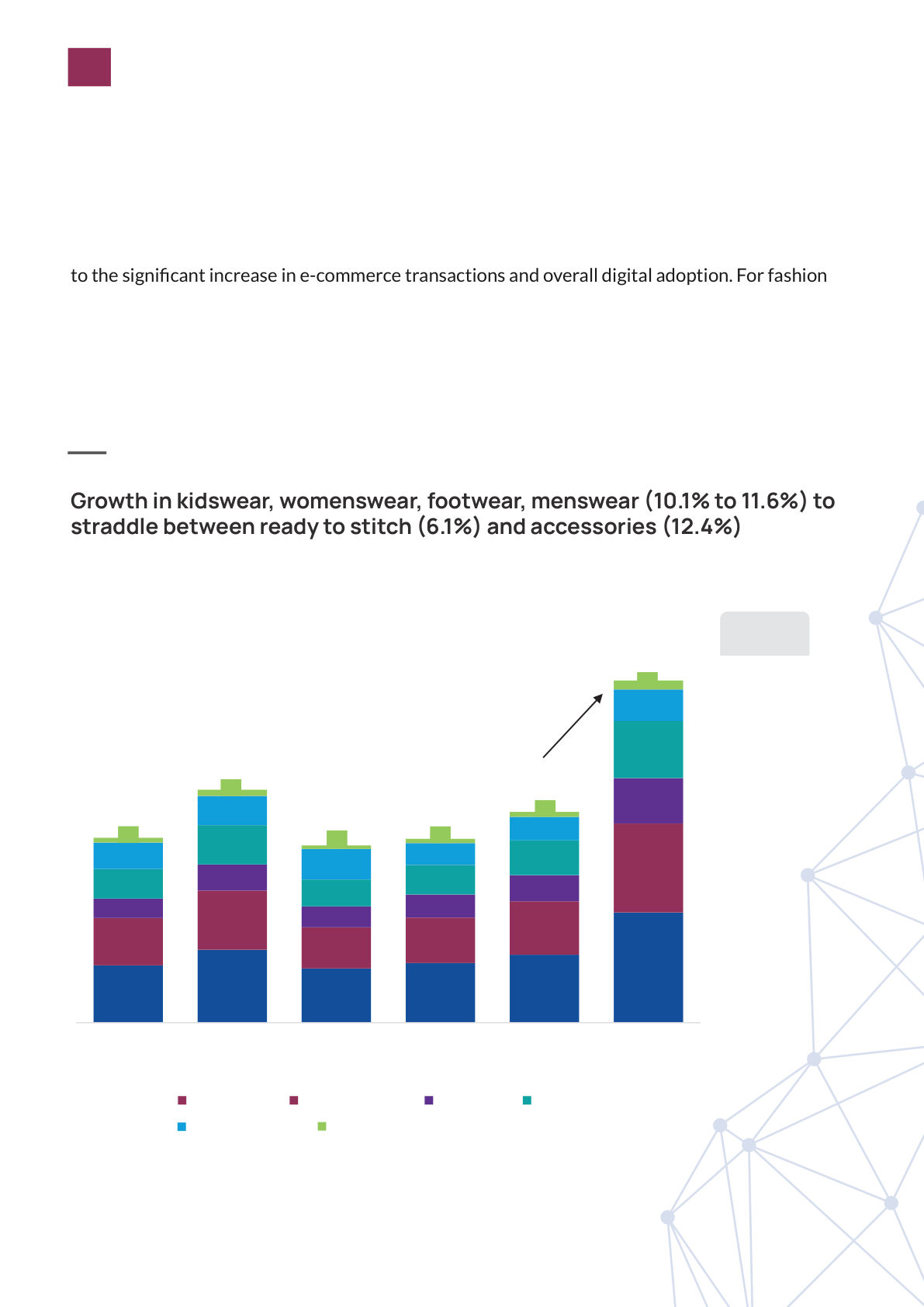
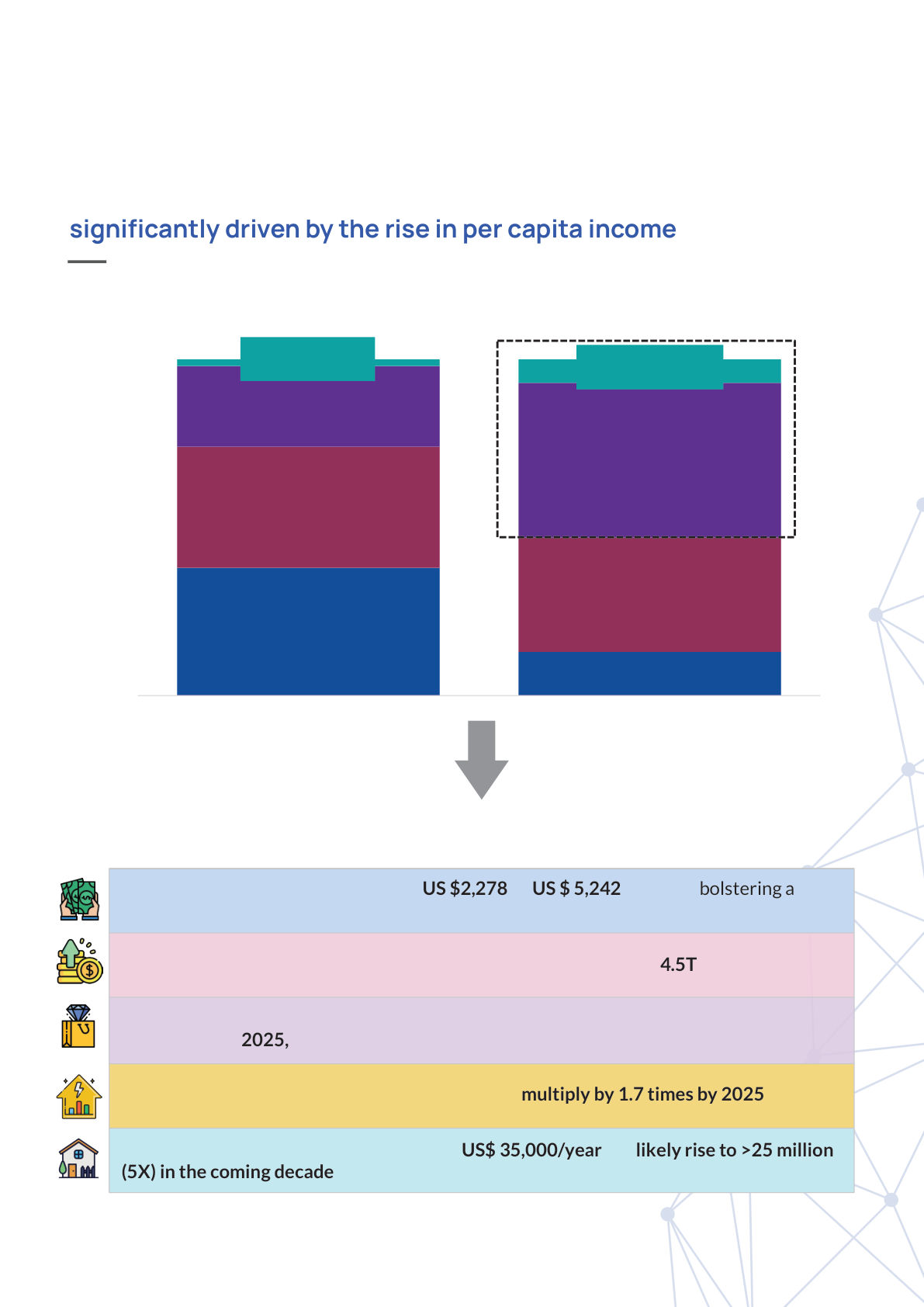
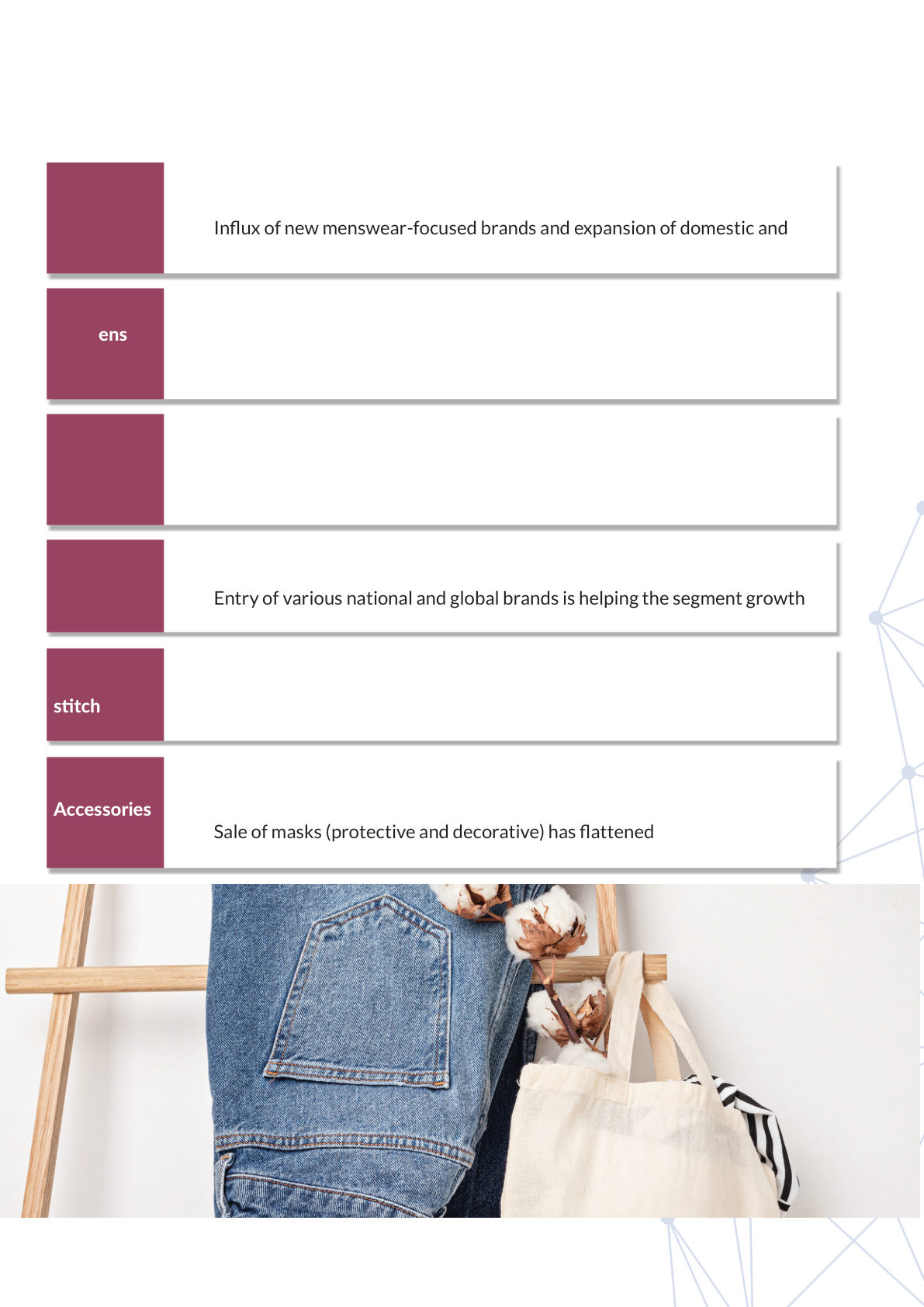
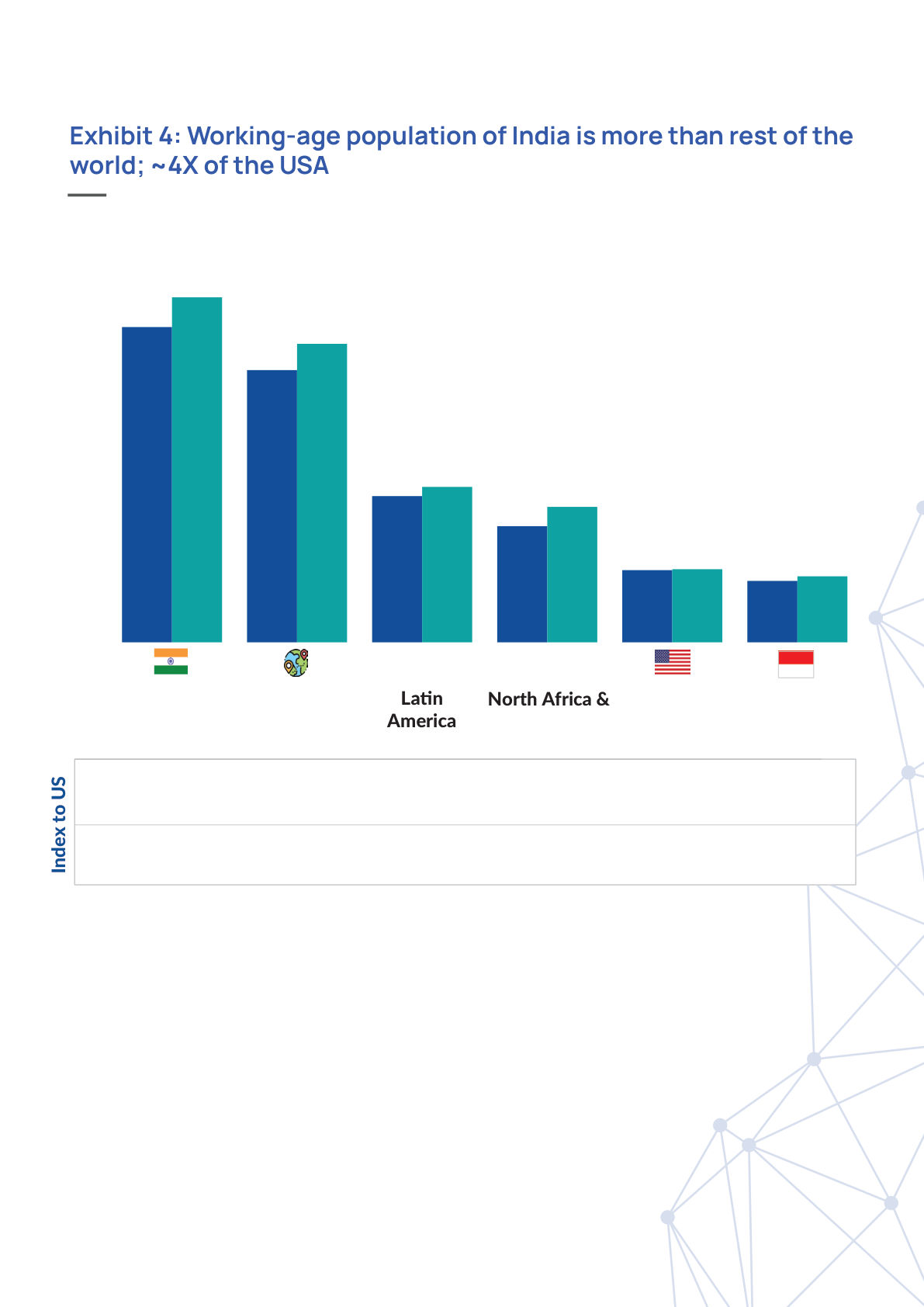
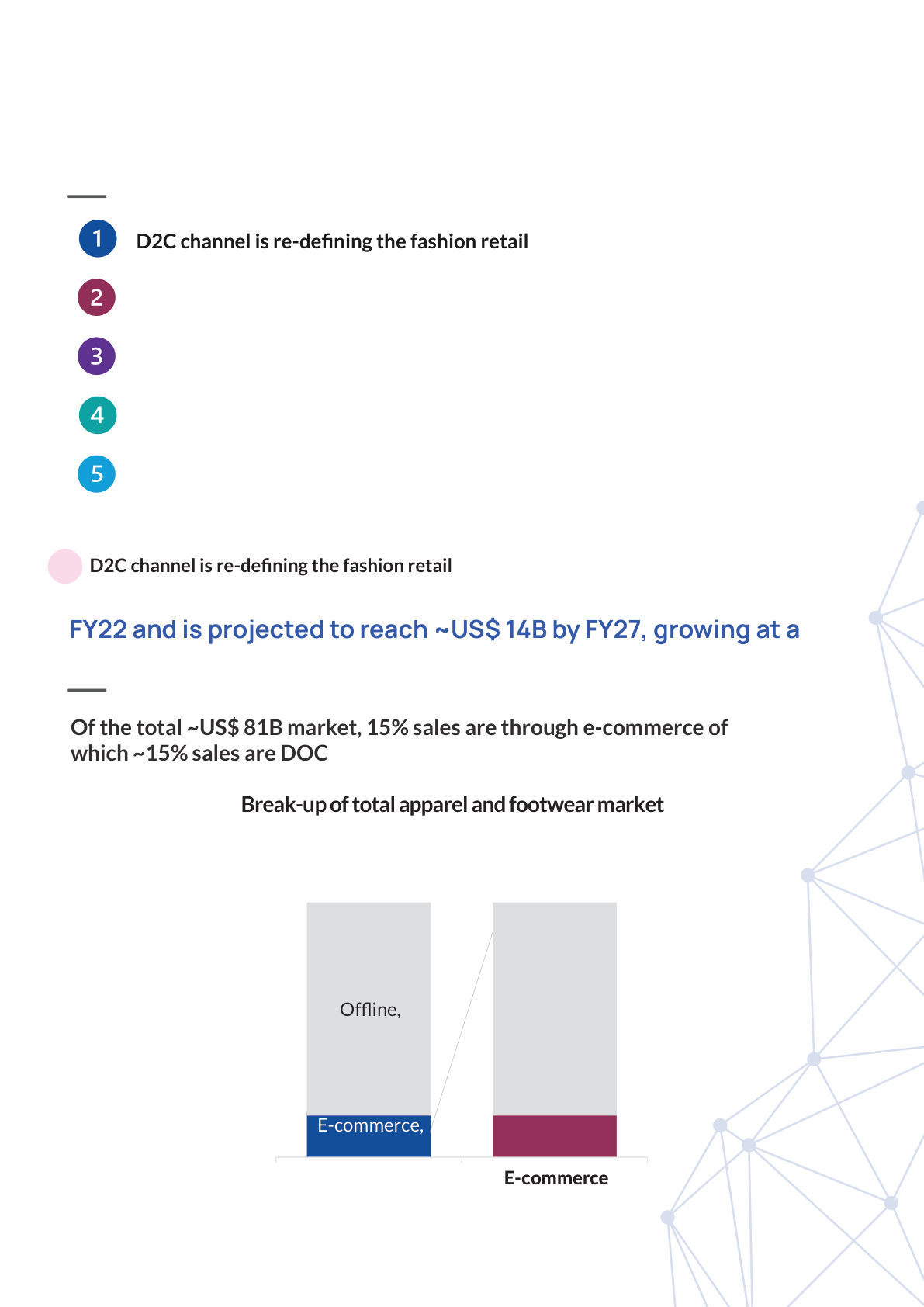
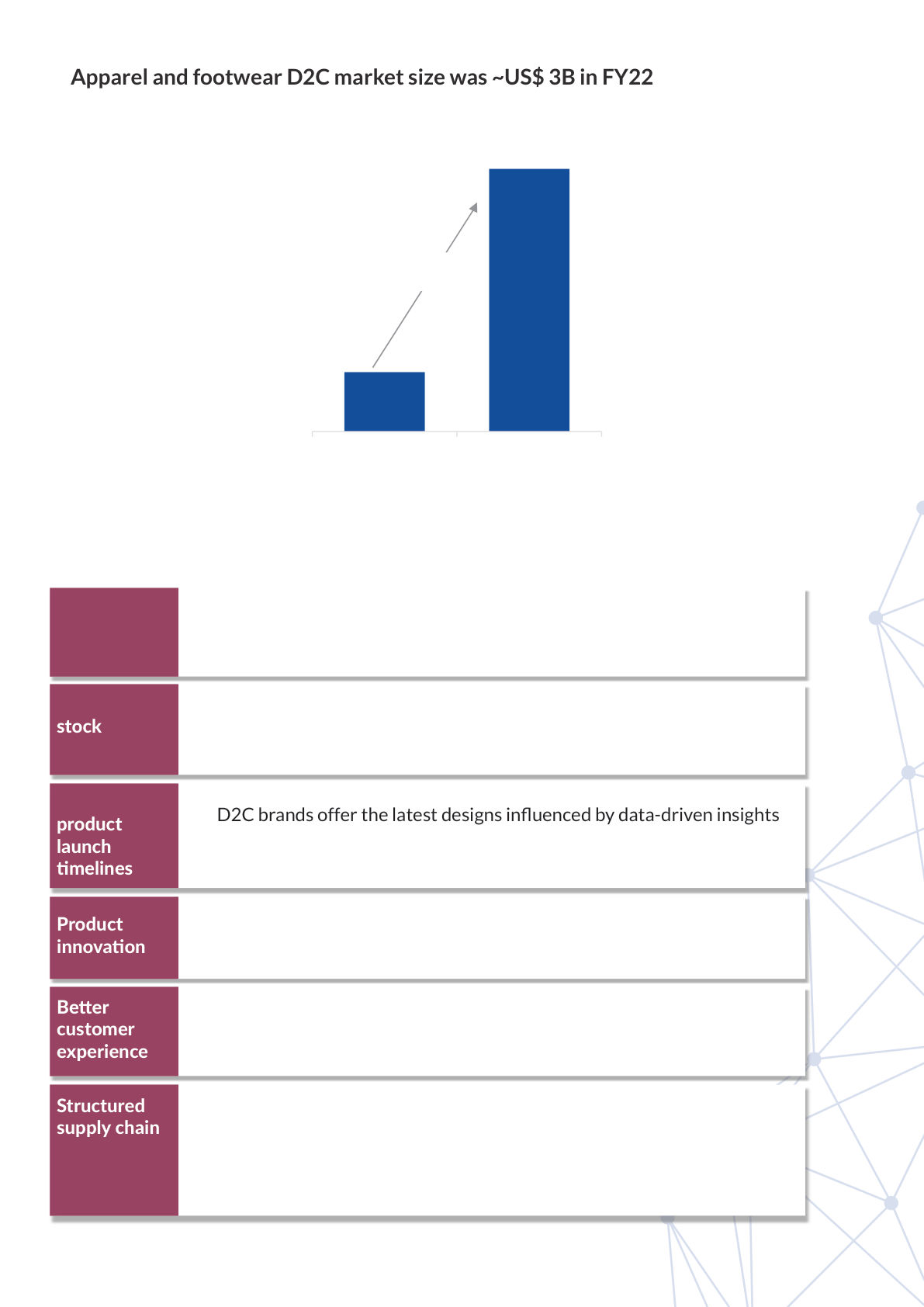
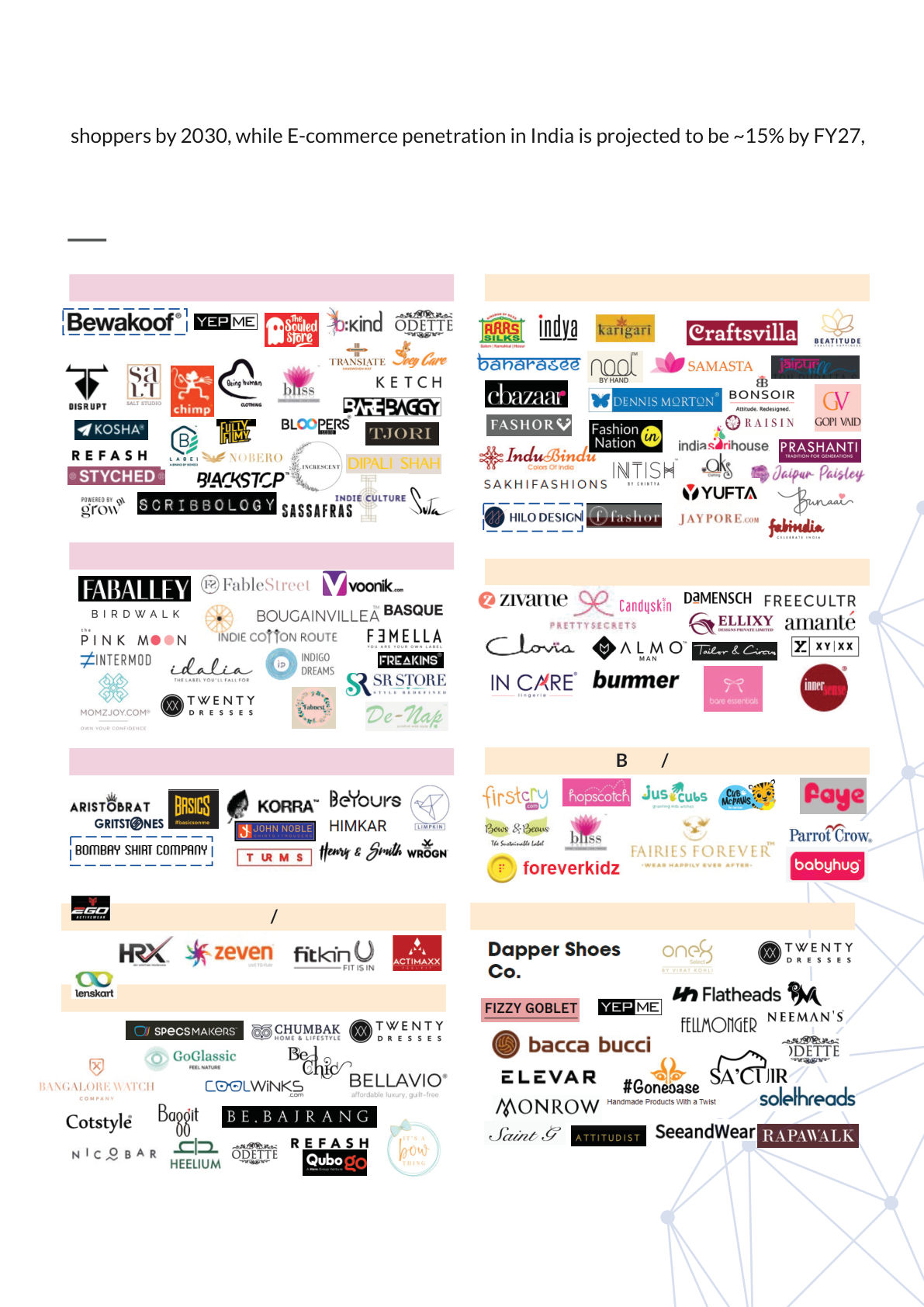
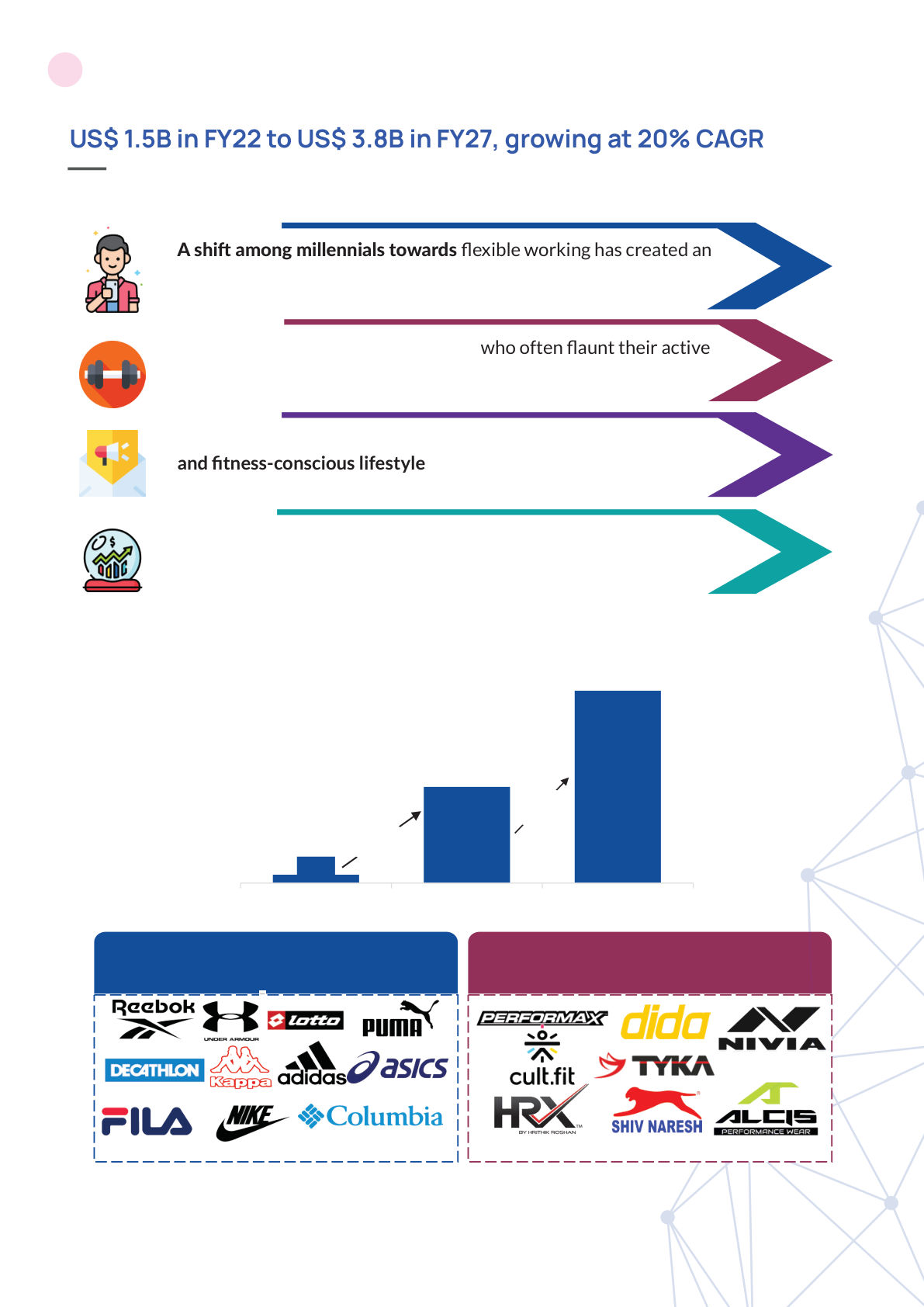
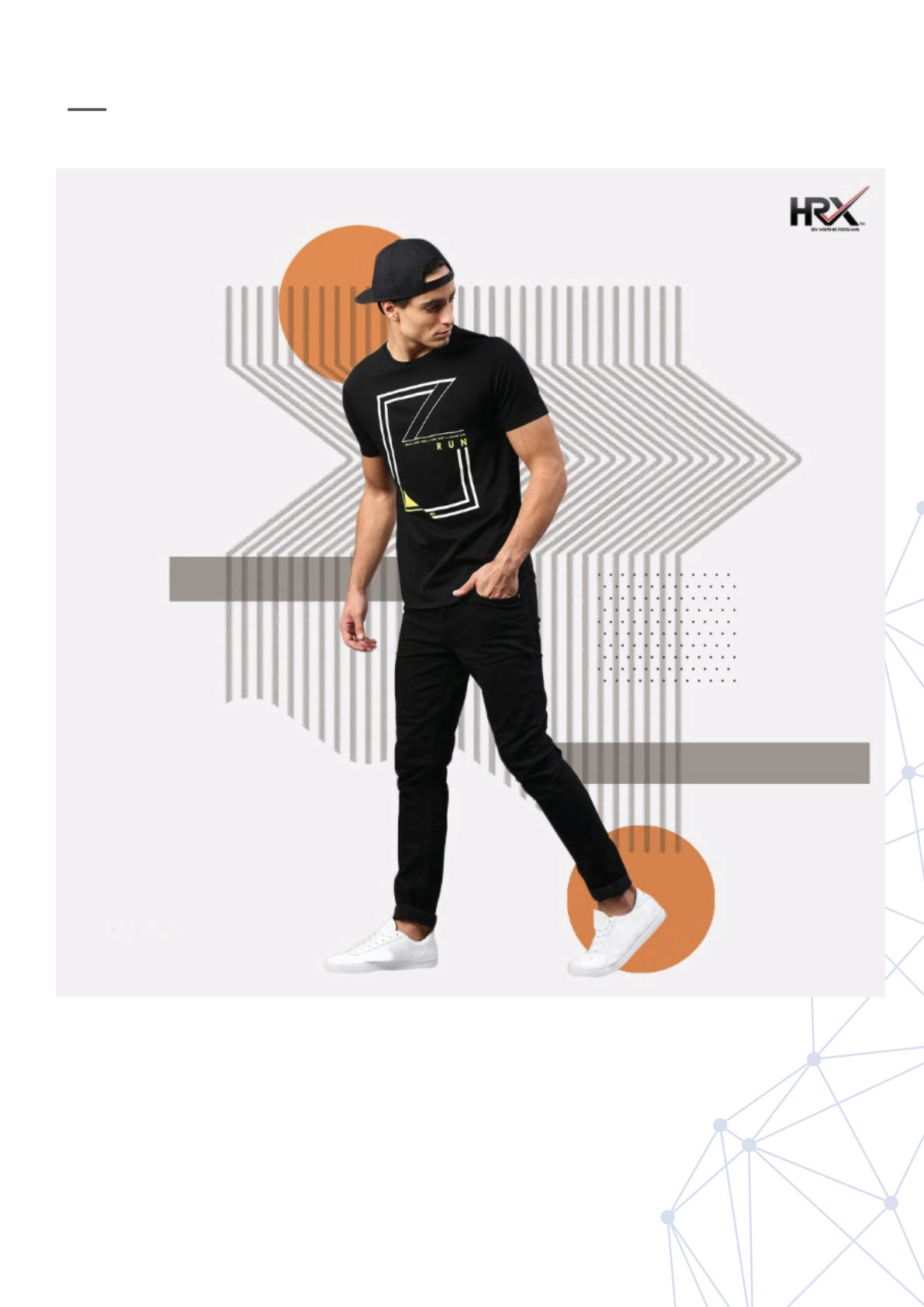
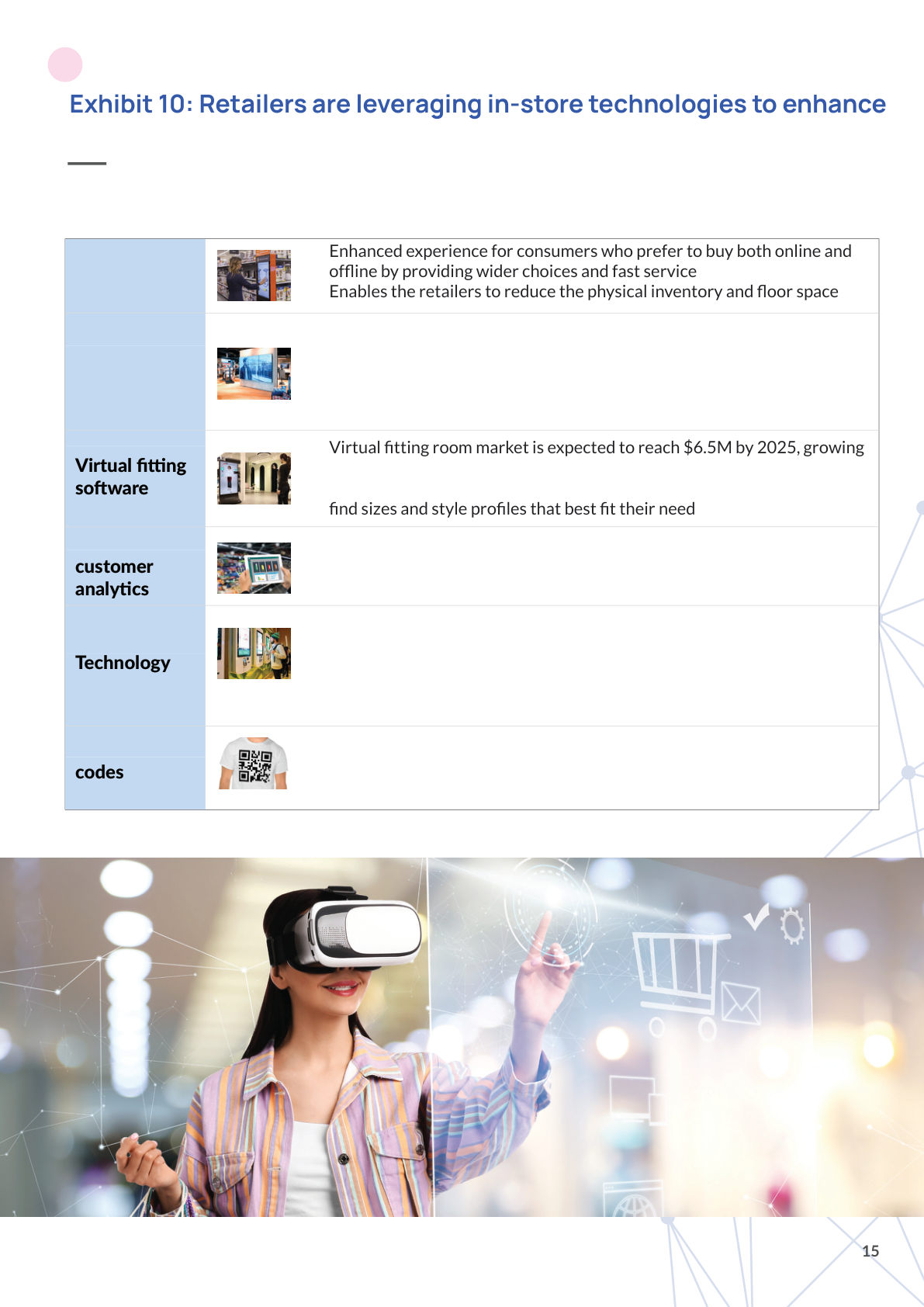
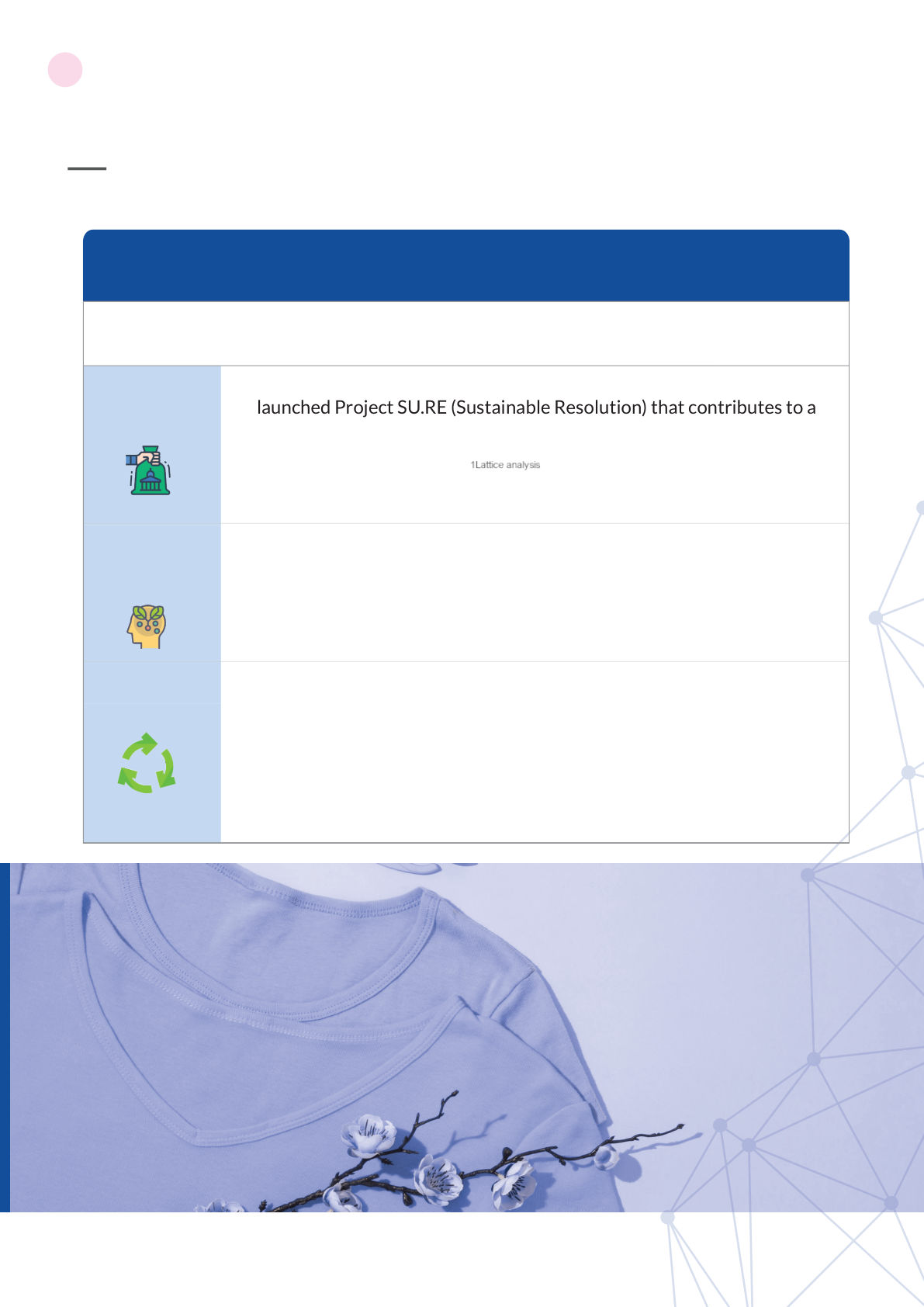
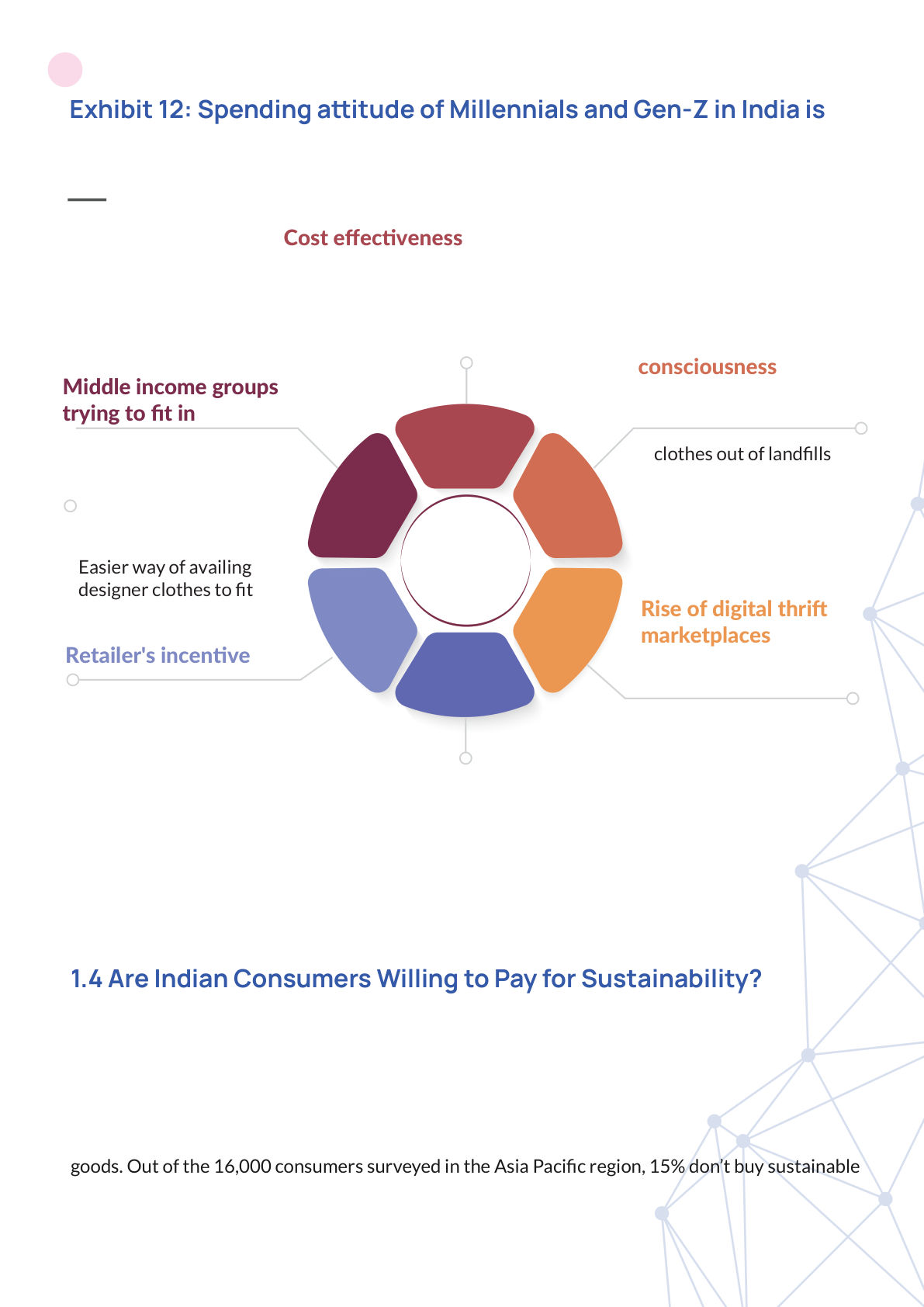
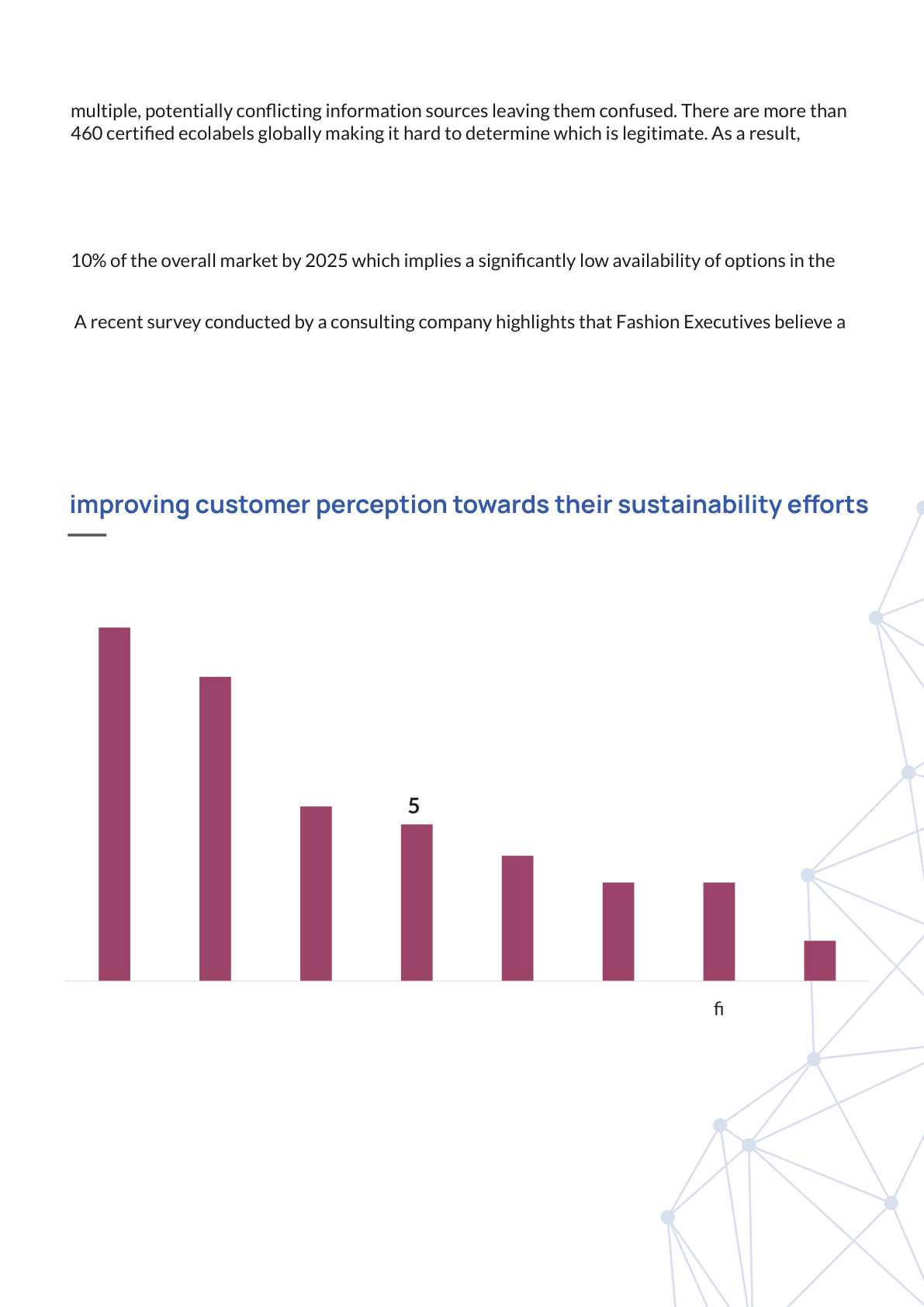
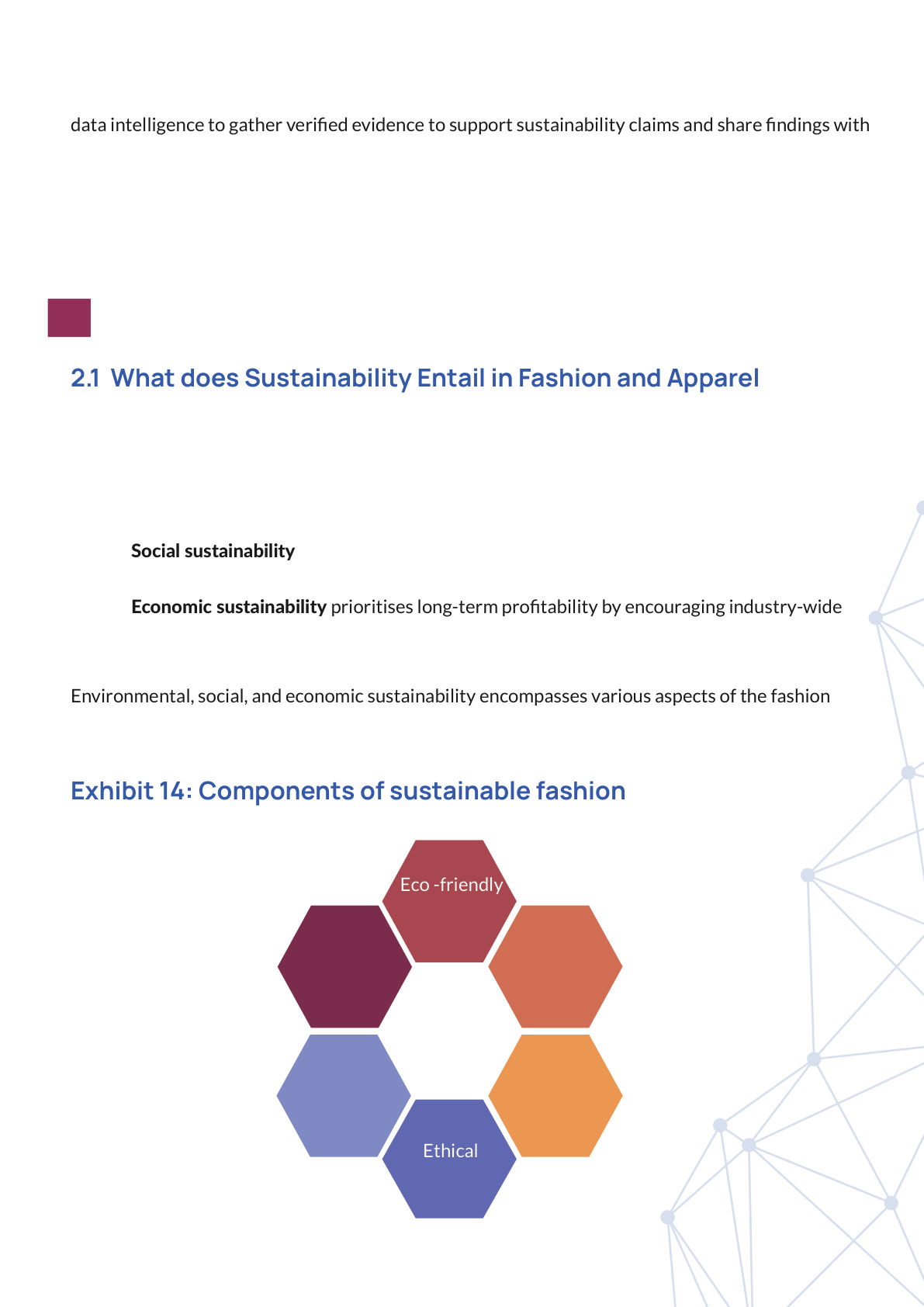
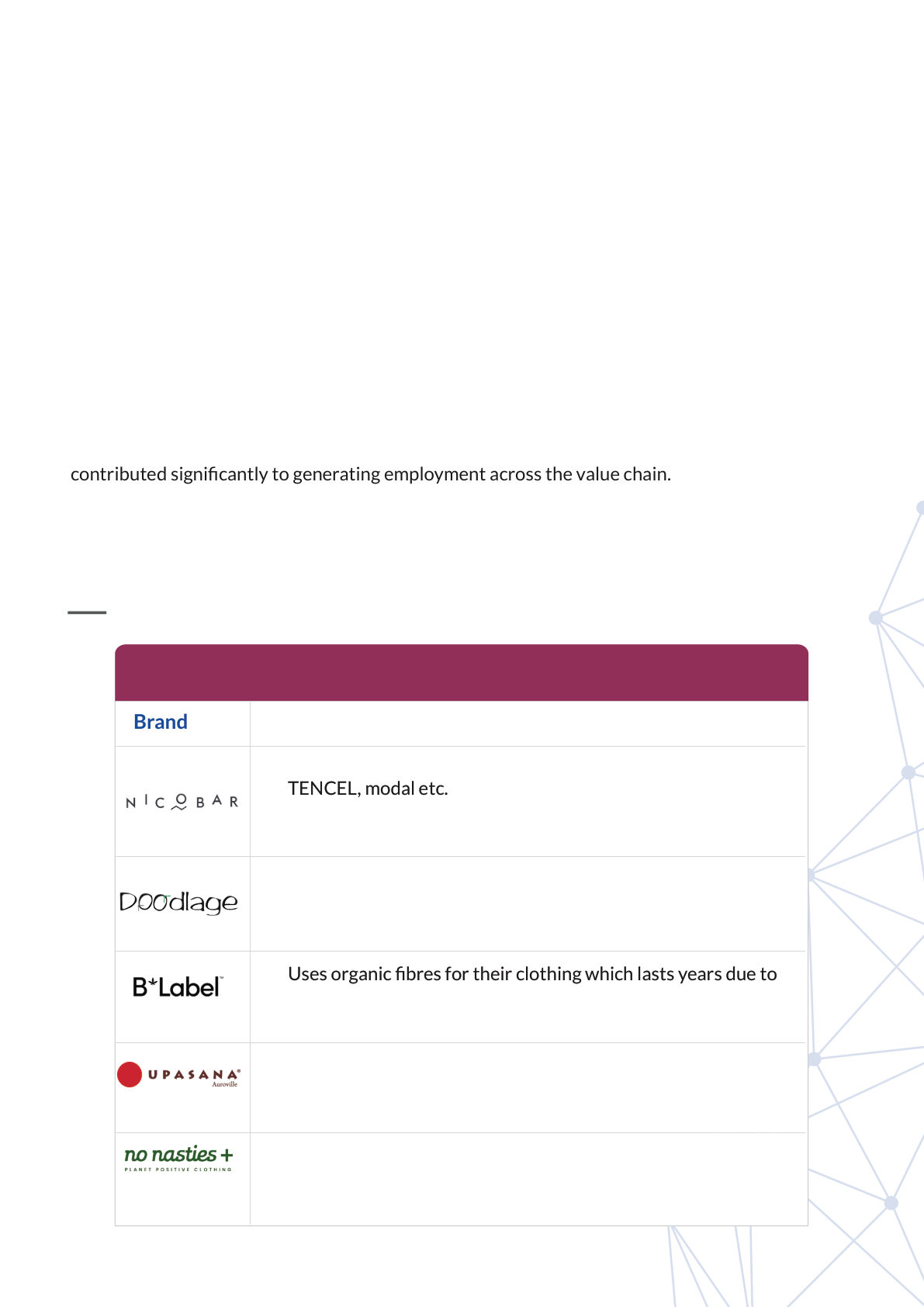
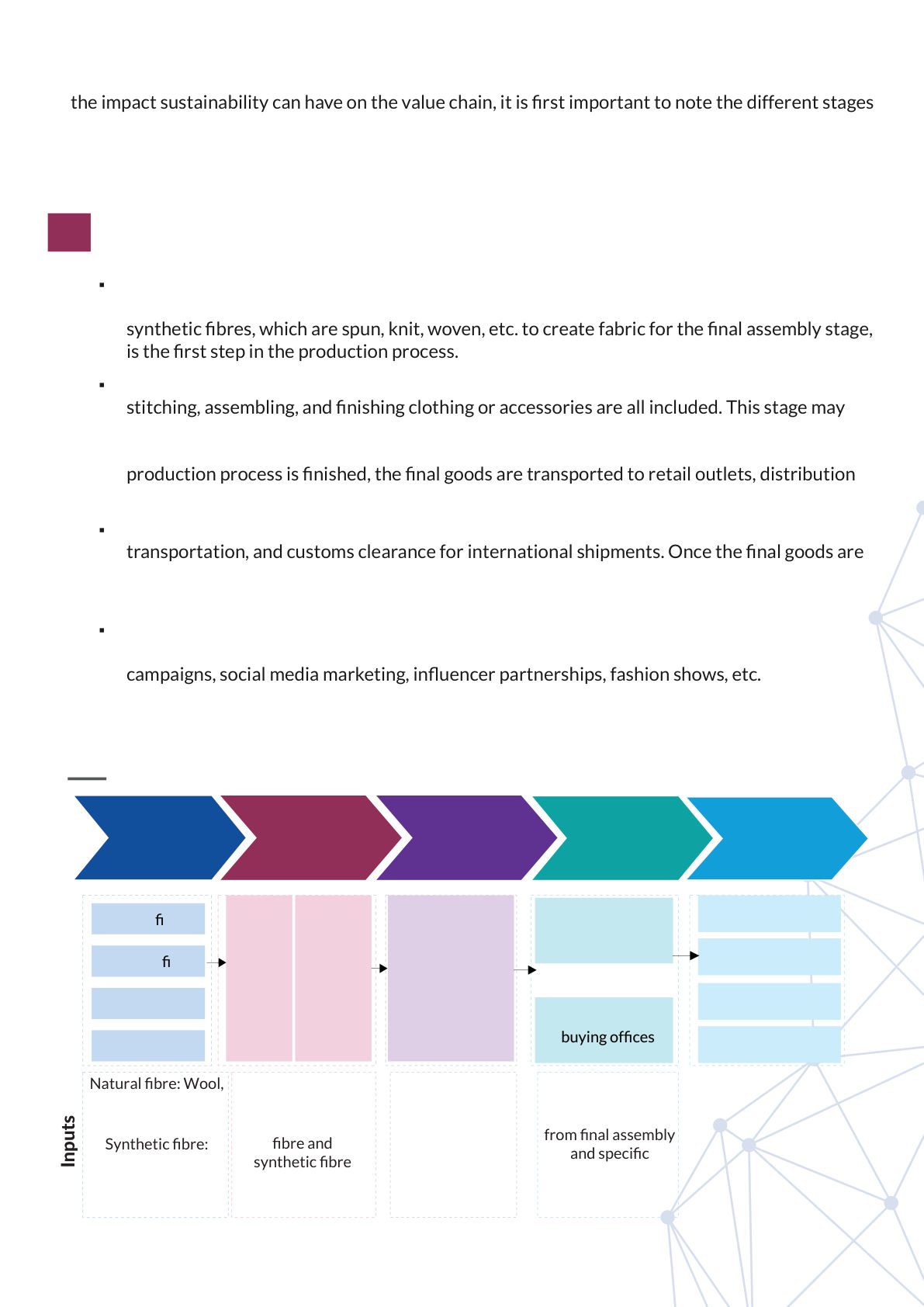
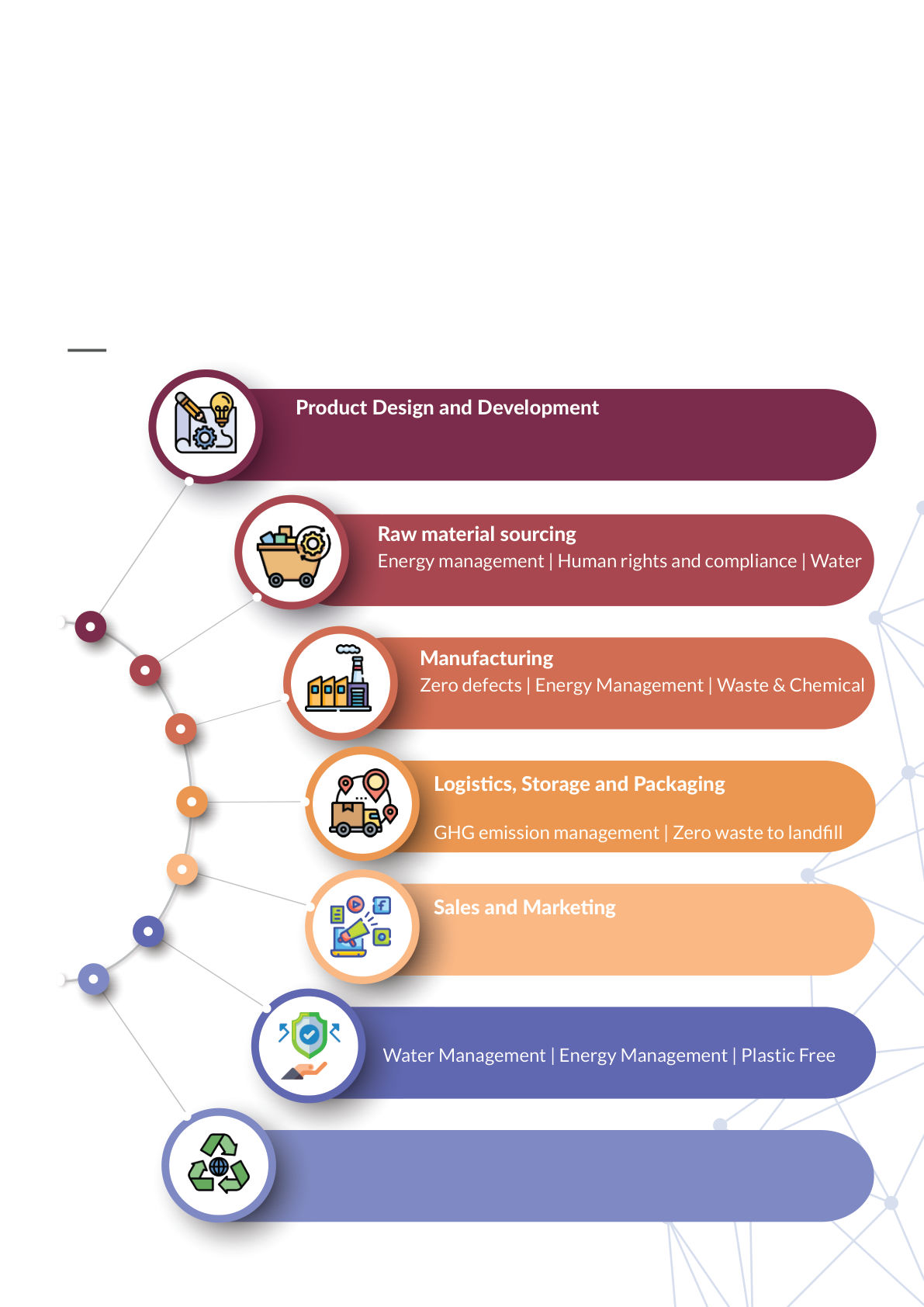
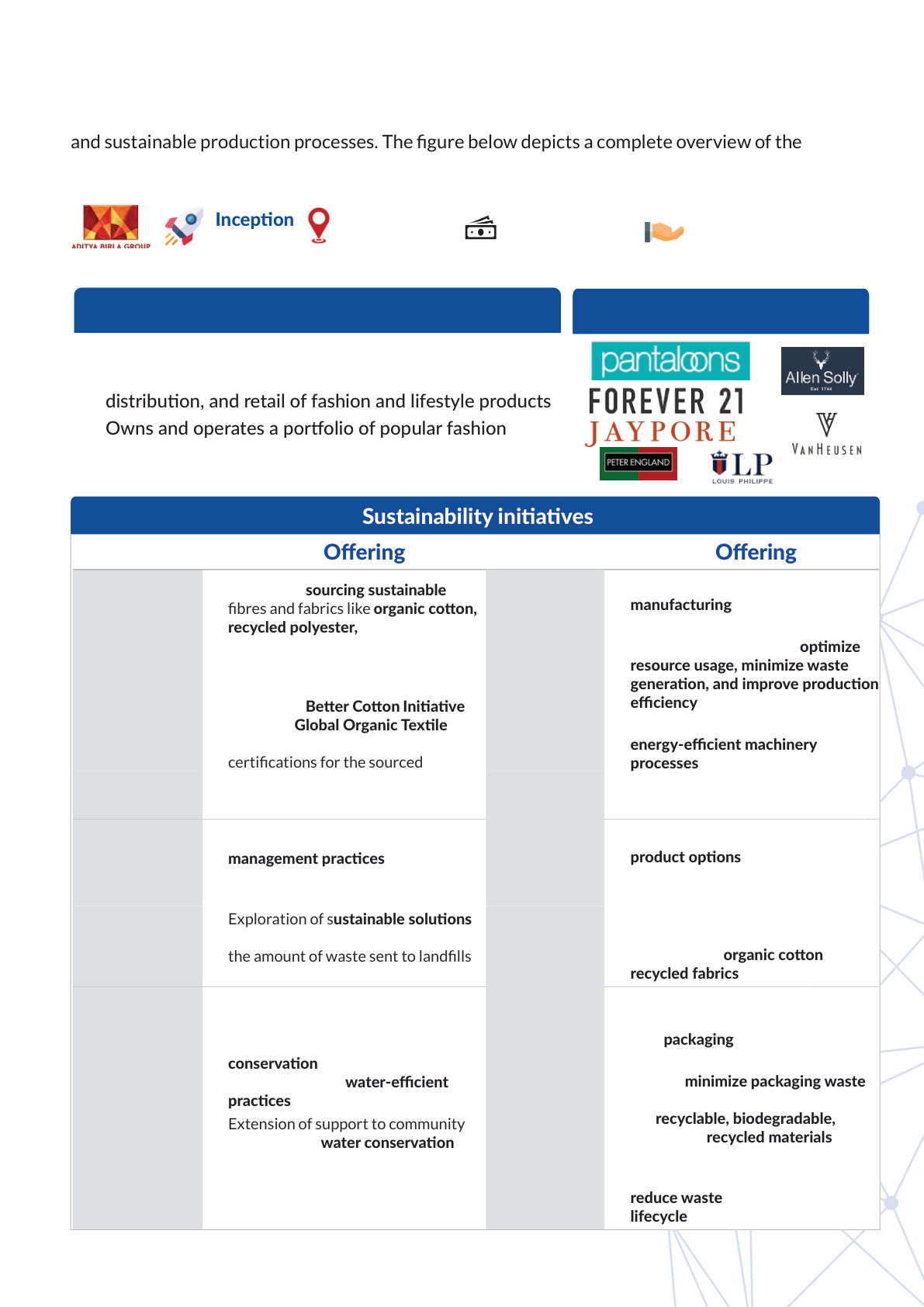
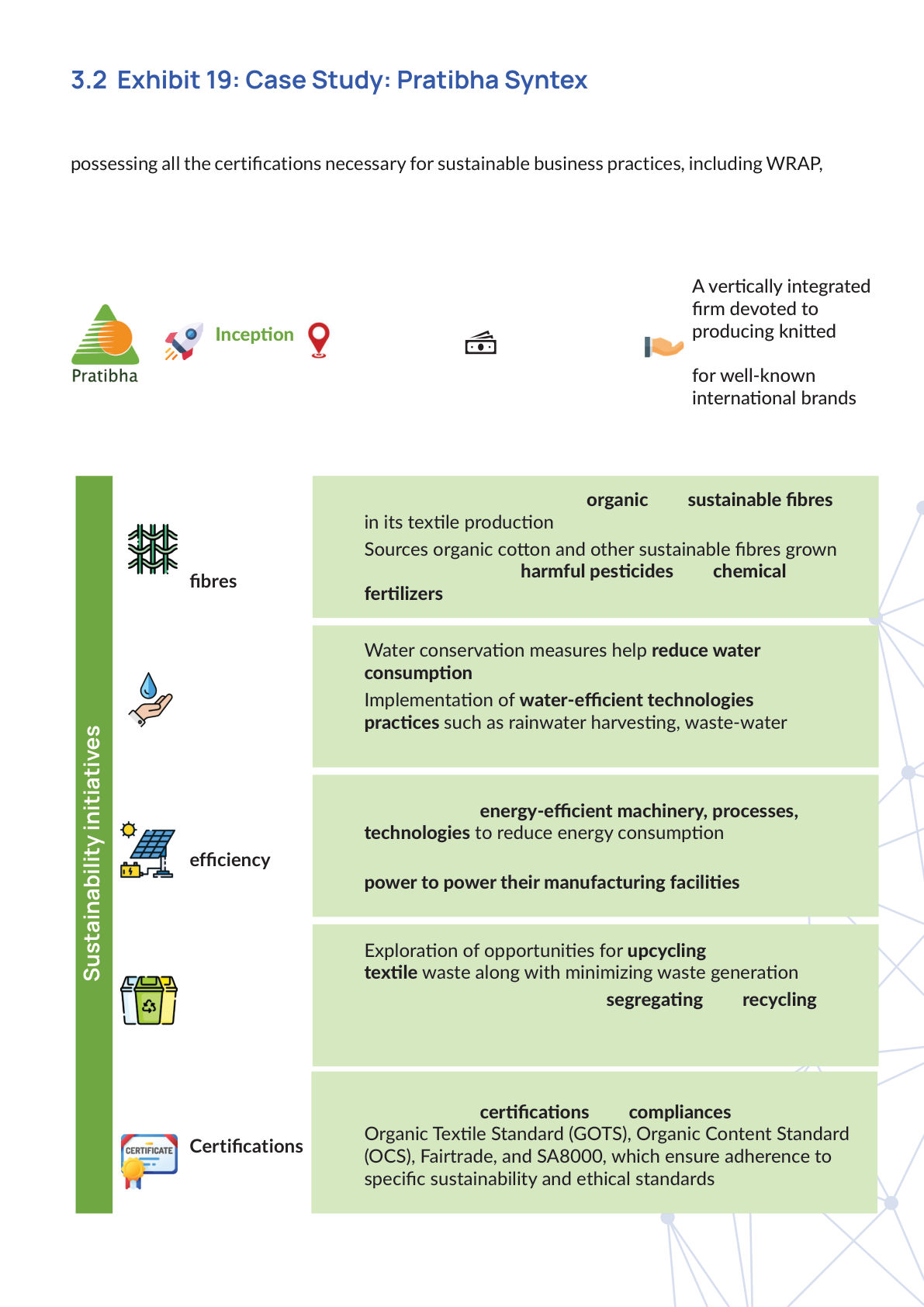
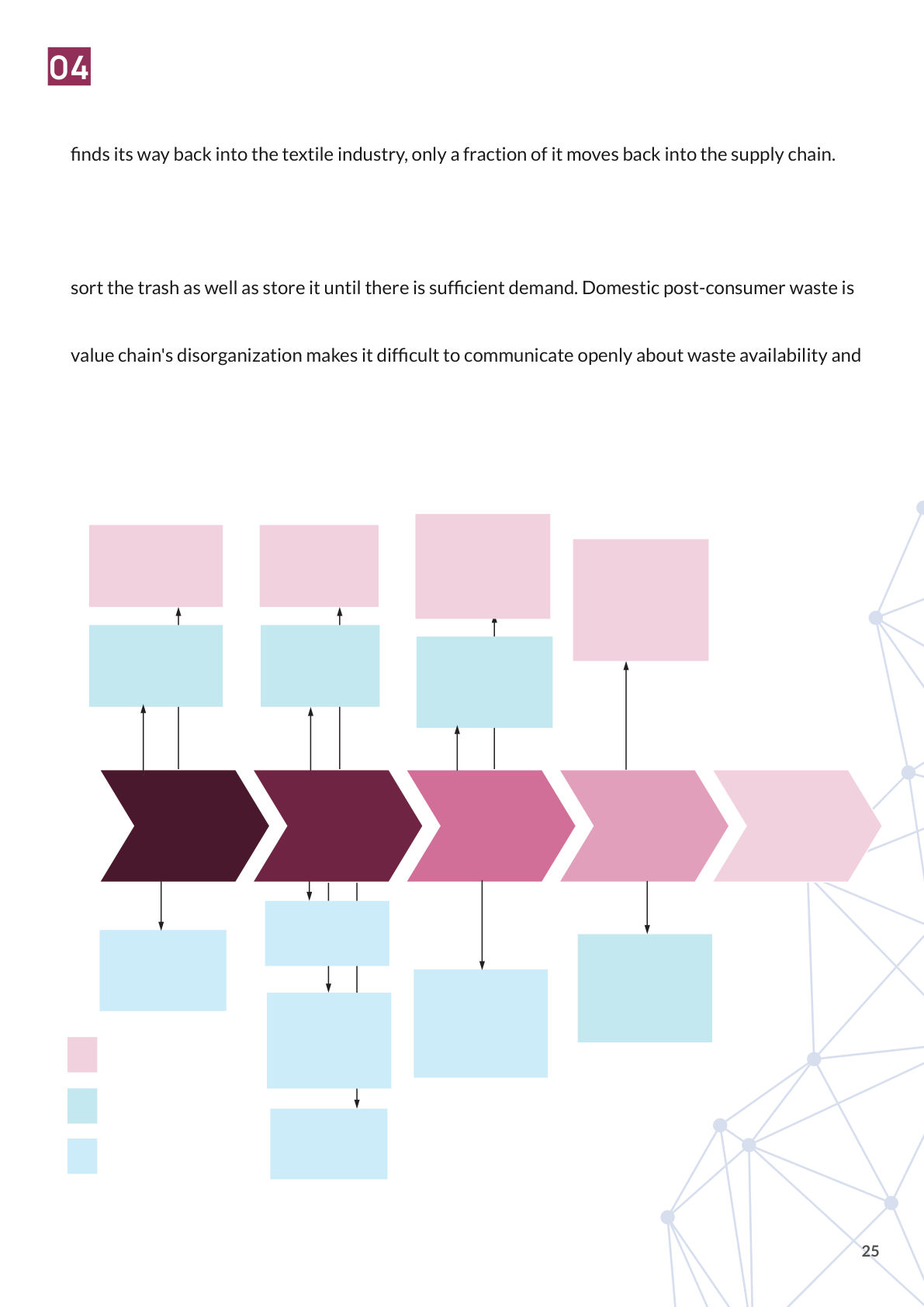
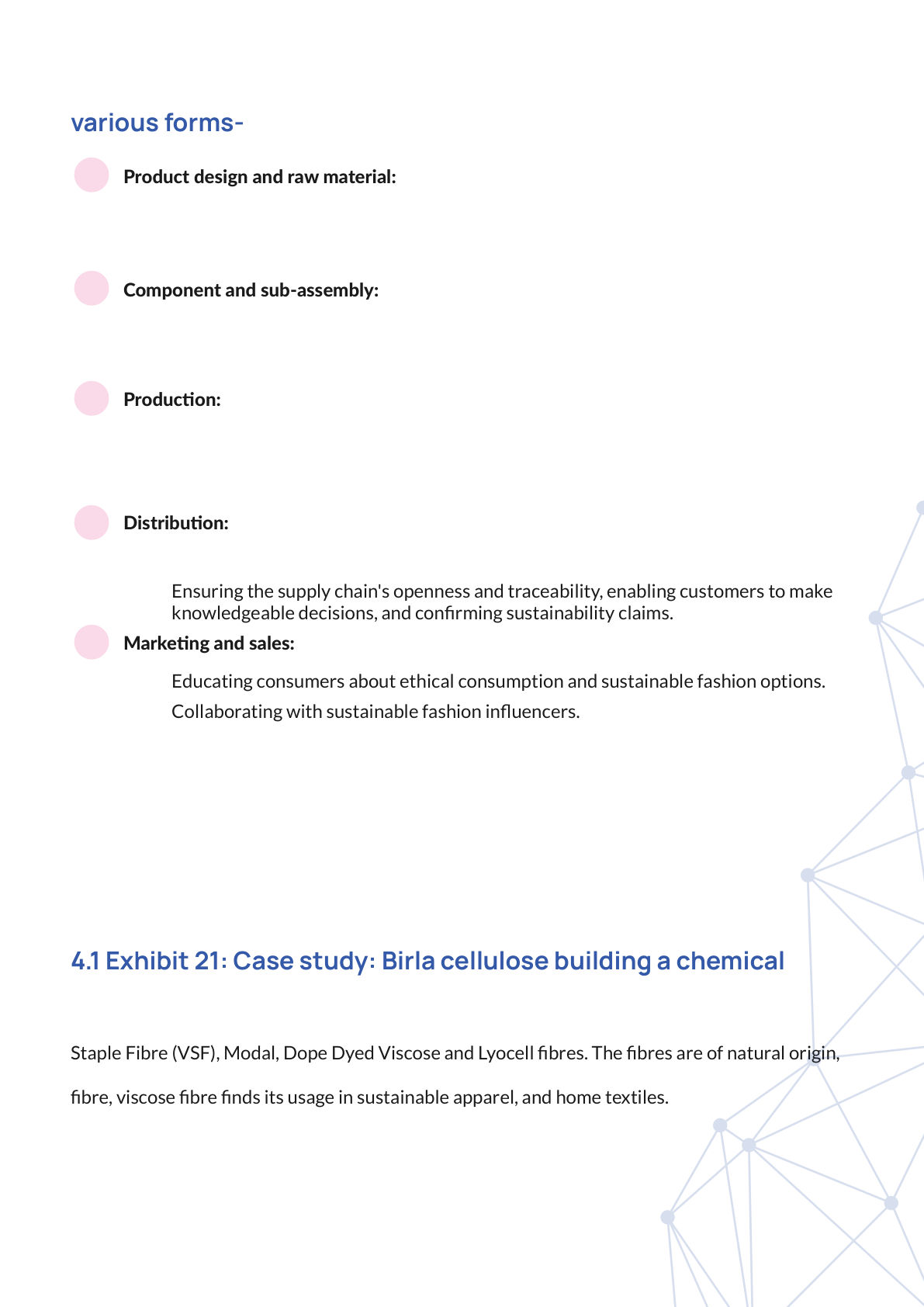
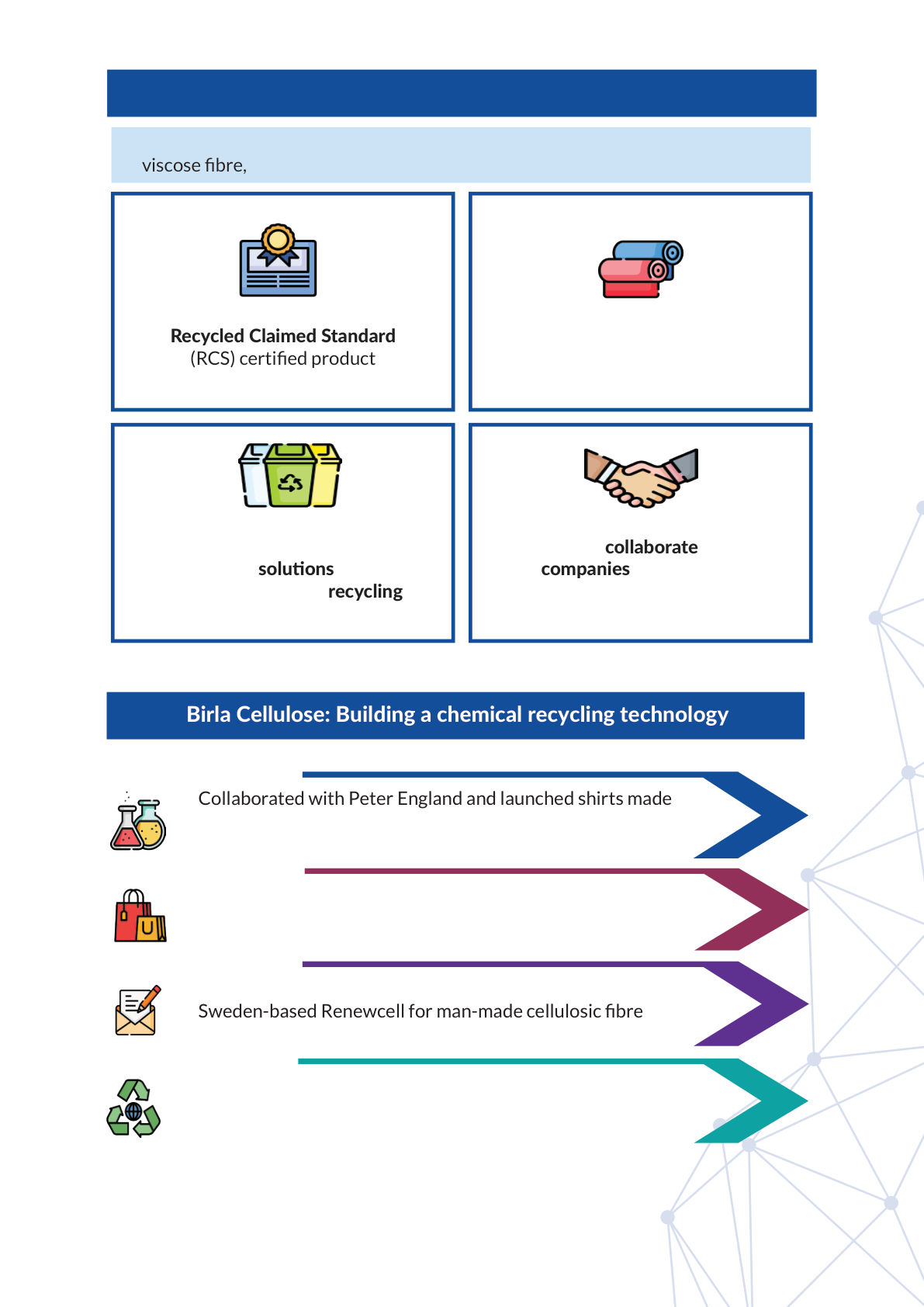
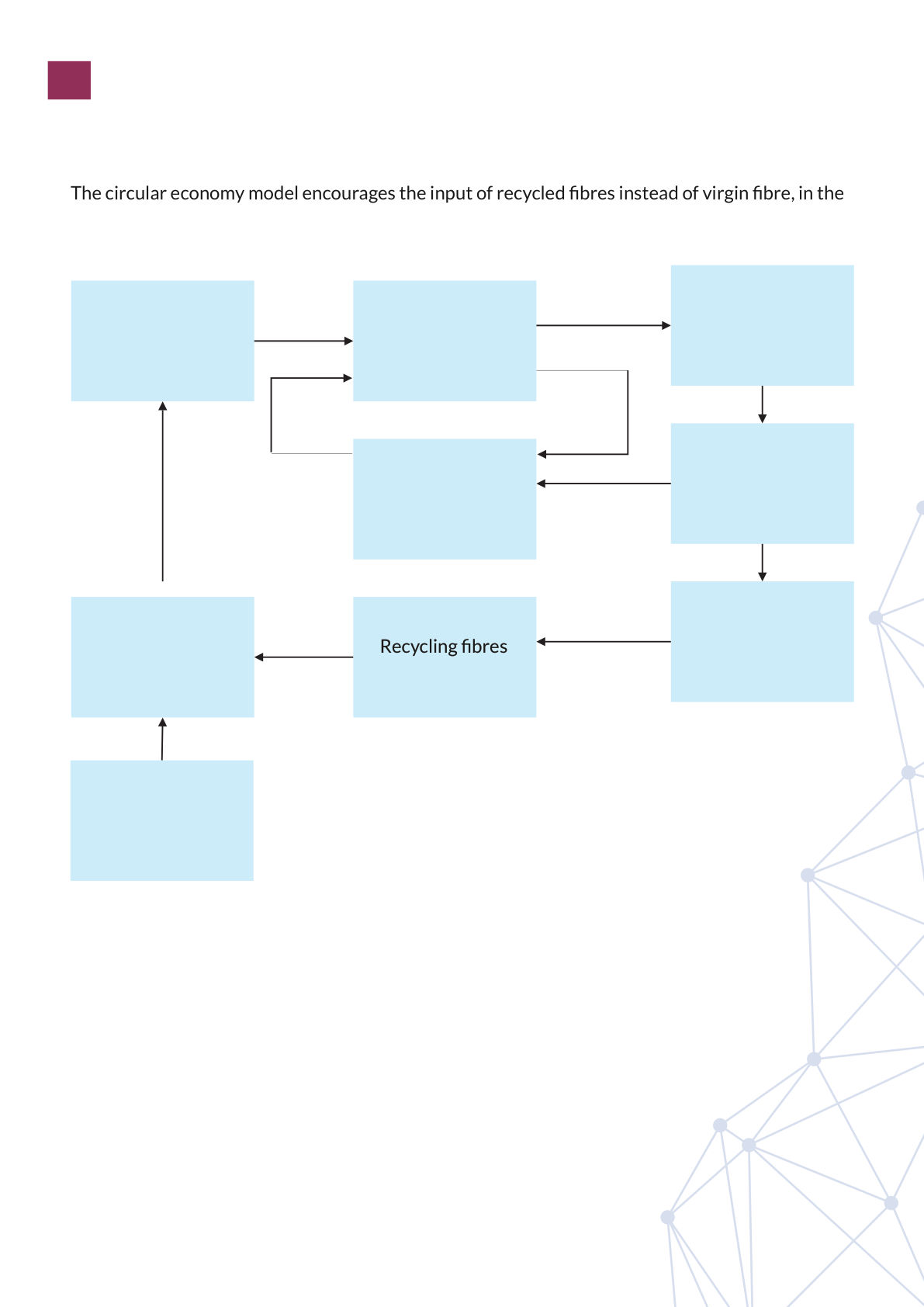
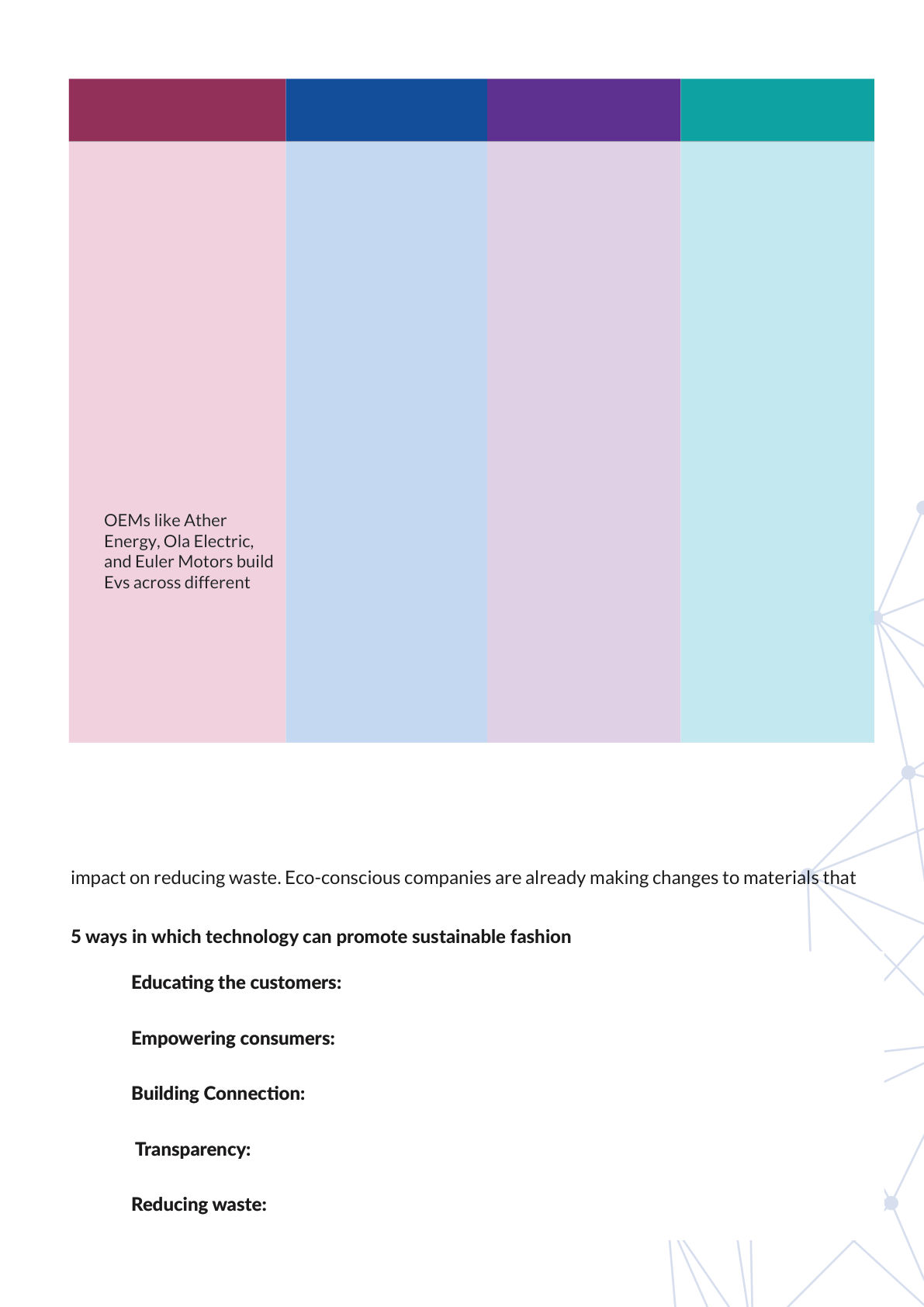
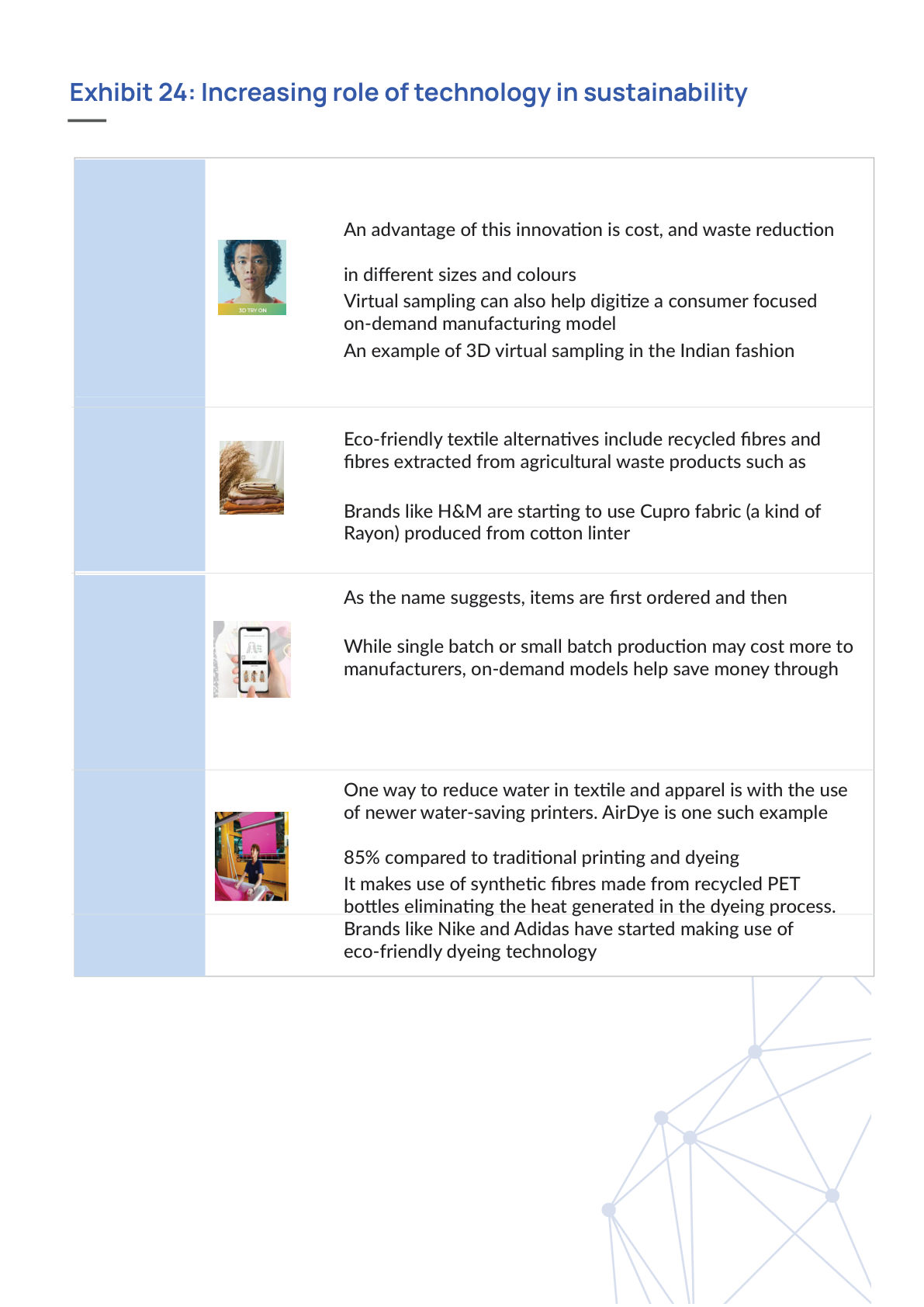
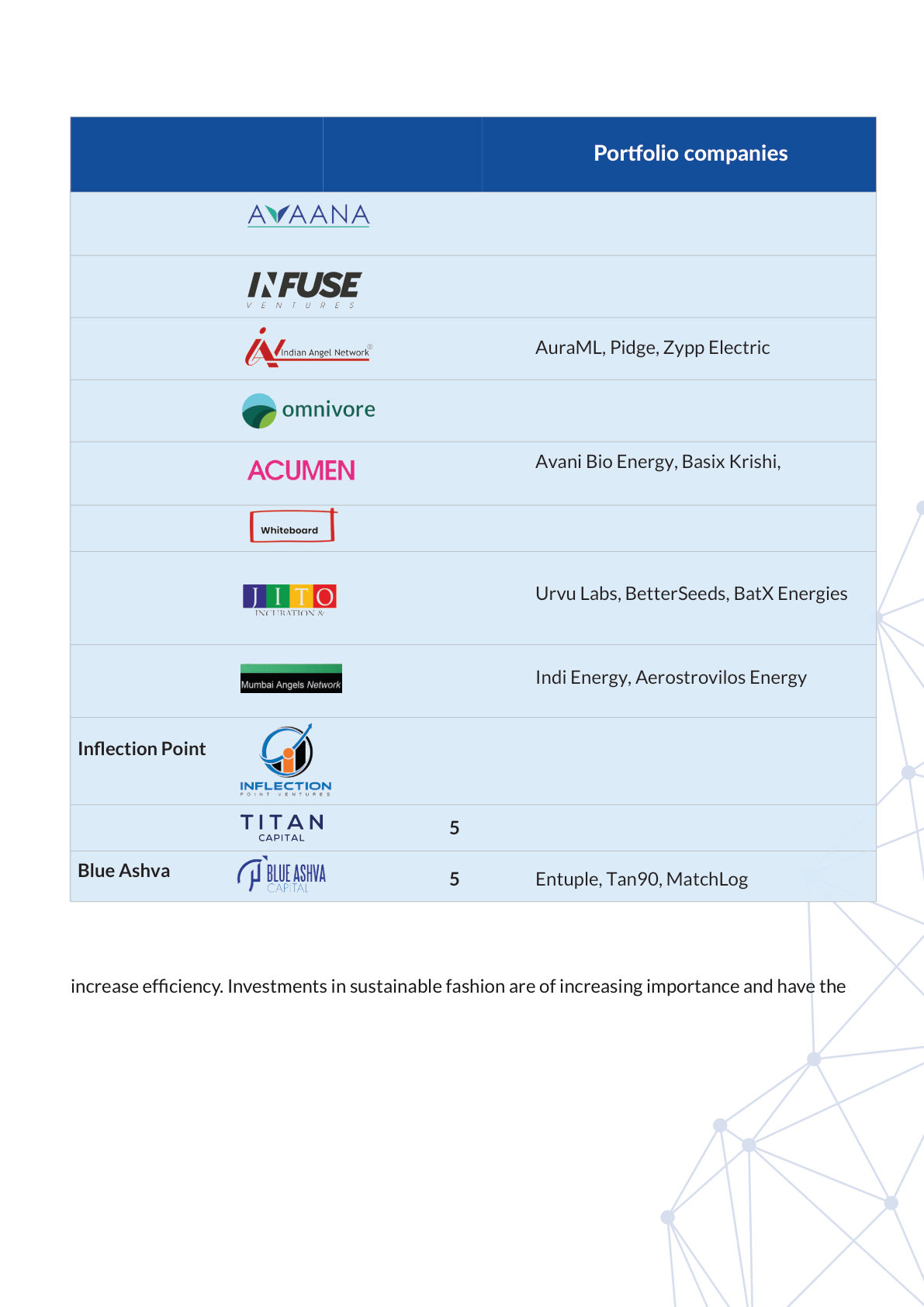
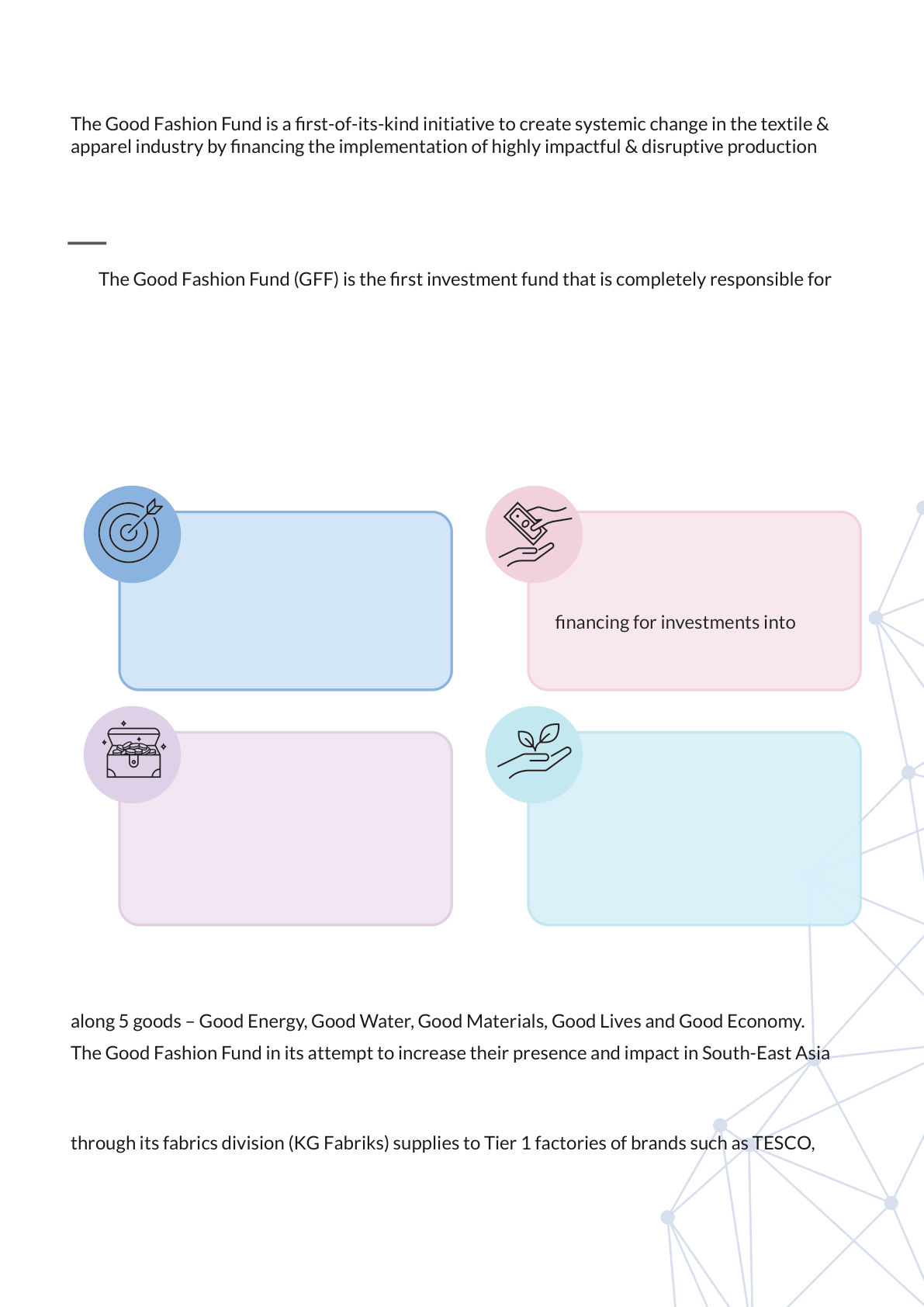
x Confidential and proprietary © Lattice Technologies Pvt. Ltd. Contents 1. Fashion and Apparel in India 1.1 Market size 1.2 Growth drivers 1.3 Emerging trends 1.4 Willingness to pay for sustainability 2. Sustainability as a trend 2.1 What does sustainability in fashion entail? 2.2 The growth of sustainability in India 3. The Fashion Value Chain 3.1 Case study: Aditya Birla Fashion and Retail 4.1 Birla Cellulose case study: Building a chemical recycling technology 5. Future of Green Fashion 5.1 Circular economy 5.2 Emerging business models in circular economy 5.3 New technologies in sustainability 6. Investment in sustainable fashion 6.1 Top 10 sustainability startup investors in India Apparel Resources Foreword system, enabling Know Your Customer (KYC) processes and bringing every individual into the banking system. This milestone was followed by the availability of the cheapest internet data plans and the affordability of smartphones, making the Internet accessible to a wide population. The subsequent introduction of the UPI payment transfer platform on mobile phones further empowered even the smallest merchants and individuals to engage in digital transactions. Looking ahead, the upcoming Open Network for Digital Commerce (ONDC) is poised to revolutionize digital purchasing, ensuring accessibility for everyone at the most been established to facilitate quick last-mile delivery. Additionally, the implementation system, fostering cohesion and simplicity. This digital transformation has brought businesses, regardless of size, and individuals meticulously recorded, leading to increased tax revenue for the government and more resources for infrastructure development and other essential systems. Furthermore, the ease and transparency of accessing money have facilitated the growth of businesses. As a result, India's retail sector is experiencing robust expansion, with fashion emerging as the third-largest expenditure category. India is projected to ascend to the third-largest economy by 2030 and the second largest by 2075—an unforeseen and exceptional phenomenon. Does this all paint a promising picture for the growth of the Indian retail sector, particularly in fashion. I won’t say that I am the original author of this idea, this came from many small pieces that I read, observed and assessed. Deepak Mohindra Chairman, Apparel Resources 1Lattice Foreword Fashion is a dynamic industry that continually evolves with changing consumer preferences and market conditions. The global fashion industry generates US$ 1.7T in annual revenues and has been displaying fast-paced growth. Indian fashion industry is the 2nd biggest industry among consumer products after food and grocery and is expected to grow rapidly in the coming decade. Amidst current challenges, sustainability presents the biggest opportunity for the fashion industry in 2023 and the coming decade. In recent years, sustainability has emerged as a critical trend, shaping the future of the fashion and apparel industry. In India, the market for sustainable clothing is still developing, but over the past few years, it has demonstrated consistent growth. According to industry reports, the sustainable fashion market in India is estimated to reach ~US$ 9B by 2025. The market’s growth will be driven by increased consumer awareness, government initiatives, circular fashion, and innovation in the startup space surrounding sustainable fashion. green fashion. It serves as a guide for industry stakeholders, offering a clear path to navigate the obstacles and leverage the advantages associated with the transition towards a more sustainable fashion ecosystem. By embracing sustainability, the fashion and apparel industry can contribute to a more environmentally conscious and socially responsible future. Ashish Dhir Executive Vice President, Consumer & Retail 1Lattice 1 Fashion and Apparel in India 1.1 Market Size Fashion Retail (apparel + accessories + footwear) is the 2nd biggest category after Food and Grocery in the overall Indian merchandise retail market of ~US$ 830B. The fashion market is expected to grow from US$ 77B to ~ US$ 126B in 2027, growing at a CAGR of 10%. While fashion market in India has not yet reached pre-pandemic levels, the outlook for the future is bright owing especially, online channels account for more than 15% of total transactions. Exhibit 1: Indian fashion market, currently at US$ 77B is expected to grow at a CAGR of 10% to reach US$ 126B by CY27 Fashion market at retail pricing in India US$ B, CY17-CY27P CAGR CY22-27P 126 10.2% 3 12.4% 12 6.1% 21 86 10.4% 77 2 68 17 67 2 65 10.7 11.6% 2 2 9 1 14 9.7 8.0 13 11.2 33 10 10.8% 11 11 10 10 7 8 22 8 20 17 17 15 40 10.3% 27 25 21 22 20 CY17 CY19 CY20 CY21 CY22 CY27P Menswear Womenswear Kidswear Footwear Ready to stitch Accessories Note(s): US$ 1 = INR 79 Source(s): Industry reports, DRHP, 1Lattice analysis © 1lattice | 06 1.2 Growth Drivers The growth of the Indian Fashion market is driven by the overall growth of the economy. India’s per capita income is to increase by over 100% by 2031 which will lead to an increase in private. Exhibit 2: Overall consumption of Indians is expected to increase Households by income distribution (US$, billion) Above 35,000, Above 35,000, 2% 7% 10,000-35,000, 24% 10,000-35,000, 46% 5,000-10,000, 36% 5,000-10,000, 34% 0-5,000, 38% 0-5,000, 13% 2021 2031P Impact of rising middle-class population India’s per capita income to rise from to by 2031, discretionary spending boom India’s private consumption to double from US$ 2T in 2022 to US$ by 2030 10M households are buying luxury goods currently and is estimated to reach ~26M households by surging a rise in luxury consumption Overall average household income is expected to Number of households earning more than are Source(s): Morgan Stanley: 'India Equity Strategy and Economics: How India Has Transformed in Less than a Decade’ report, 2022, Press releases, secondary research, 1Lattice analysis © 1lattice | 07 Exhibit 3: Category wise drivers of growth • Increasing disposable income, urbanization, and attention to grooming and appearance Menswear • foreign brands/retailers in Tier I and II cities • Increasing female labor force participation in the white-collar workforce • Wardrobe expansion in both ethnic and western wear and a shift from wear need-based buying to aspirational • Rising number of young population & nuclear families • Active participation in purchase due to media exposure, family’s spending Kidswear disposable income on kids • Increasing penetration of schools with uniforms • Brand-conscious millennials & exposure to global fashion trends Footwear • Ready to • Market growth due to women seeking exclusive, customized ethnic wear like designer wear which is more accessible now • Covid decreased demand for apparel accessories with more WFHs which is expected to continue. • Source: 1Lattice analysis © 1lattice | 08 This rapid growth can be attributed to the growing working-class population in India. Working-age population demographics (in million) 1,052 961 910 830 474 446 413 354 220 223 187 201 India Rest of the US Indonesia world Middle East 2022E 4.4x 3.8x 2.0x 1.6x 1.0 0.9x 2031P 4.7x 4.1x 2.1x 1.9x 1.0 0.9x Source(s): Articles, secondary research, company reports, 1Lattice analysis © 1lattice | 09 1.3 Emerging Trends The Fashion and Apparel market in India can be characterized by the following trends: Exhibit 5: Emerging trends in the apparel industry Athleisure is the fastest growing segment Increasing role of technology for better retail experience Demand for sustainable fashion is increasing Re-commerce market is booming 1 Exhibit 6: Apparel and footwear D2C market size was ~US$ 3B in CAGR of 35% to direct online channel market FY22, % US$ 80.7B US$ 11.9B Marketplaces, 85% 85% Direct online channel, 15% 15% Total apparel and Footwear market market Source(s): Industry reports, 1Lattice analysis © 1lattice | 10 Apparel D2C market US$ B CAGR 14 35% 3 FY22 FY27P Source(s): Industry reports, 1Lattice analysis Key success factors for D2C brands Margins • Apparel and footwear product category ensures high AOVs with good and AOV margins ranging between 40 – 60% Regular • D2C brands update their designs, and styles regularly to keep the customers engaged and to increase repeat purchase frequency update Design to • through granular data analysis, thereby minimizing the time required from design to product launch • Innovative offering in terms of style, cloth material • D2C brands ensure better customer experience especially across sub-categories – women’s innerwear, eyewear • Well-established agile supply chain to minimize inventory risks and and lower serve high demand volatility inventory risks Source(s): 1Lattice analysis © 1lattice | 11 Apparel and footwear>D2C landscape India is expected to have 1.3B+ smartphone users and internet users and ~500M online giving rise to rapidly growing D2C market in India. Exhibit 7: Apparel and footwear: D2C landscape Apparel Exclusive ethnic wear Exclusive women’s wear Intimate wear Exclusive men’s wear aby Kids’ wear Activewear athleisure Footwear Accessories Note(s): This is not the exhaustive list of brands Source(s): Secondary research, 1Lattice analysis © 1lattice | 12 2 Athleisure is the fastest growing segment Exhibit 8: Indian athleisure market is expected to increase from Growth drivers acceptance of a more casual dress code in the workplace, therefore, witnessing a rise in the athleisure category The popularity of gyms and athletes, lifestyle and fashion choices on social media channels have also led to the rise of athleisure Brands are promoting products as an essential element of a healthy thereby leading to higher sales Growing demand for sports, yoga activities and fast-changing lifestyle has added to the popularity of athleisure Indian athleisure market US$ B 3.80 CAGR 20% 1.50 CAGR 21% 0.13 FY10 FY22 FY27P Existing international brands Existing Indian brands in athleisure in athleisure Note(s): Athleisure includes sportswear and activewear Source(s): Industry reports, 1Lattice analysis © 1lattice | 13 Exhibit 9: Athleisure clothing example Source(s): HRX Athleisure collection © 1lattice | 14 3 Increasing role of technology for better retail experience customer experience Increasing role of technology in retail • Endless aisle • • The Indian digital signage market is expected to surpass US$ 1628.5M by 2028 at a 15.2% CAGR Retail digital • Increases visitor engagement in a retail store signage • As per research, 80% of people visited a shop because digital signage captured their attention • at 13.44% CAGR • VFS allows retailers to create custom-sized charts enabling customers to In-store • Technology such as Merakis helps retailers understand the behavior of consumers in-store and allows retailers to make more informed decisions thus creating a smooth in-store shopping experience • Interactive kiosks engage consumers and makes them more invested in Digital kiosks the store • Increases employee productivity • Data from the digital kiosks can be used by retailers to decide which segments are gaining traction • Such codes allow consumers to scan product details at any point of their Two-way QR purchase journey meanwhile providing customer insights to retailers • Retailers can choose the content that they want to show to the consumers Source(s): Industry reports, 1Lattice analysis © 1lattice | 4 Demand for sustainable fashion is increasing Exhibit 11: Rise in demand of sustainable fashion has led to an increase in the consumption of conscious clothing Growth drivers Support from the government and increasing consumer demand is driving growth Key growth Description drivers • In association with the top 16 retail brands, Ministry of Textiles has Regulatory support cleaner environment – a step towards a responsible and smart business • Signatories have pledged to source or utilize a substantial portion of their total consumption using sustainable raw materials and processes • Consumers are shifting towards reducing waste, increased recycling, Conscious being considerate of product life cycles, and supporting sustainability consumers • As per a recent survey, 83% people consider sustainability while buying fashion products • Circular fashion aims to keep cloths and materials in use through Circular recycling, repurposing and avoiding where possible making completely fashion new products • Results in reduction of amount of ecologically harmful waste in the environment Source(s): Industry report, 1Lattice analysis © 1lattice | 16 5 Re-commerce market is booming shifting towards thrifting, driven by environmental consciousness and cost sensitivity • Pre-owned clothes are recycled at a discounted price • Trending / premium quality clothes are available at cheaper prices Environmental • Reduces carbon footprints and keeps 01 • Re-commerce has paved the way for the low / • Re-commerce facilitates middle income millennial recycling and reusing 06 02 groups to follow fast items rather than Rise of fashion trends producing new ones thrifting • in India into rich societies 05 03 • Accelerated growth of 04 digital thrift marketplace • Retailers are looking to ranges from offering a expand into resale to large variety of content boost revenue and (eBay, Poshmark, etc.) to increase customer loyalty One-of-a kind-wardrobe curated content targeted • Retailers enjoy improved to niche segments • Motivation to build a unique margins in some cases by (TheRealReal, etc.) closet with a variety of clothes selling the same items at affordable prices multiple times Source(s): Industry report, 1Lattice analysis According to a recent report by a leading consulting company, 60% of consumers in India are willing to pay a premium for sustainable products while 52% of consumers in urban India expect to increase spending on sustainable brands in the next three years. However, the report also highlights that while Indians show intent and ability to purchase sustainable products, only a few actually follow through, something they called the “say-do-gap”. Brand owners, therefore, face a fundamental challenge of whether or not to produce sustainable goods because of a lack of information or because they don’t trust claims of sustainability. 10% mentioned low availability, while only 16% cite price as a barrier. © 1lattice | 17 One of the challenges cited to overcome the “say-do-gap” is faced in the pre-purchase stage when consumers are trying to understand sustainability messaging. Consumers are overwhelmed by consumers have a nascent understanding of sustainability. The survey also highlighted that while higher price is a challenge while shopping sustainably, nearly 85% of problems are non-price, supply-side factors like lower quality, lack of variety, low availability, and lack of sustainable alternatives in the market. In India, sustainable fashion is expected to reach market. lack of standardized tools and metrics is the greatest hurdle to improving how consumers perceive their sustainability efforts. Exhibit 13: 79% of fashion executives believe that a lack of standards to assess sustainability performance is the biggest hurdle to 79% 68% 39% 3 % 28% 22% 22% 9% Lack of Cost of Reduction ffective Insuf cient Hiring Compliance Quality of standards sustainable sustainable of environ- marketing budget talent with to assess materials materials mental sustainability sustainability impact expertise performance linked with supply chains Source(s): BoF-Mckinsey state of fashion 2023 Survey © 1lattice | 18 The obvious way to combat this issue is to ensure that companies invest to close the say-do gap to ease the consumer journey and earn loyal promoters. One way to do this is to invest in research and stakeholders transparently. Vague terms like “green” or “eco-friendly” which aim to greenwash brands and have different interpretations should be avoided. Instead, context with concrete and factual information should be provided. For example, when the fast-fashion giant Shein launched a resale platform for American consumers, it was accused of greenwashing as research found that resale platforms typically do not help to decrease production levels, particularly for fast-fashion brands. 02 Sustainability as a Trend In the fashion industry, sustainability usually refers to a trilogy of social, environmental, and economic sustainability: • Environment sustainability involves using sustainable materials such as recycled or upcycled materials, cutting water consumption during production processes and reducing the industry’s carbon footprint. • aims to create safe working conditions for individuals engaged in manufacturing and to pay workers fairly along the entire supply chain. • responsible investment and ensuring that sustainability measures are affordable for businesses. industry, such as eco-friendly or green fashion, conscious and ethical fashion, vegan or cruelty-free fashion, and recycled or circular fashion. and green fashion Conscious Circular fashion fashion Sustainable fashion Vegan and Upcycled and cruelty free recyclable fashion Source(s): 1Lattice analysis © 1lattice | 19 Sustainable fashion, therefore, seeks to promote the use of environmentally friendly materials and production techniques that reduce their negative effects on the environment and enhance the social and economic condition of industry workers. 2.2 The Growth of Sustainable Fashion in India The market for sustainable clothing is still developing, but over the past few years, it has demonstrated consistent growth. According to industry reports, the sustainable fashion market in India is estimated to reach ~US$ 9B by 2025. The market’s growth will be driven by increased consumer awareness, government initiatives, and circular fashion. One of the most encouraging developments in the sustainable fashion market is the emergence of sustainable fashion startups. Many entrepreneurs in India are creating eco-friendly and ethically produced brands to meet the rising consumer demand. Sustainable practices are being used across the supply chain to guarantee that goods are socially and environmentally responsible. These startups have not only introduced innovation to the sustainable fashion market but have also Exhibit 15: Emerging Indian apparel brands focusing on sustainable fashion Emerging Indian apparel brands focusing on sustainable fashion Description • Nicobar focuses on using sustainable fabrics like bamboo, • No chemicals and pesticides are used in the production process • Doodlage upcycles factory waste, recycles post-cutting scraps and post-consumer waste into new fabrics • Its waste is also segregated and made into accessories • qualities like mold and mildew resistance, UV rays resistance, and carbon negative • They make use of handlooms, natural dyes, block prints, organic cotton, healing textile and upcycling in order to reduce energy consumption • Its clothing is made up of 100% organic cotton, 100% fair trade factories, vegan and in the absence of any harmful chemicals © 1lattice | 20 Sustainability can be introduced in different parts of the value chain in several forms. To understand in the textile and apparel supply chain which is complex and comprehensive in nature. In the following section, we dive into the nitty-gritties of the Fashion as well the Textile Waste value chain. 03 The Fashion Value Chain The fashion value chain starts with product design and development. This involves creating styles, choosing fabrics, and creating sample designs. The procurement of either natural or The real manufacturing of fashion items takes place at the production stage. Cutting, take place inside the brand's manufacturing facilities, or it may be contracted out to manufacturers, who are frequently based in nations with lower labour rates. Once the centres, or warehouses. Logistics and distribution involve activities such as inventory management, warehousing, distributed to different channels, they are sold to end consumers through various retail formats like e-commerce platforms, pop-up shops or Direct-to-consumer channel. To raise awareness of their brands and increase demand for their products, fashion brands then participate in marketing and promotional activities which include advertising Exhibit 16: Overview: Fashion supply value chain Design, Component Raw Final marketing and sub Distribution materials Assembly assembly and sales Department Brand Name Natural bres stores Clothing Knitting, Companies Yarn Sewing, Pressing, Speciality stores Synthetic bres Weaving, spinning Buttonholing, etc. Cutting, etc. Trim Chain stores Overseas Online Machinery Cotton, Silkworm Pieces of fabric Finished apparel silk etc. from the Spinning: Natural Knitting, weaving, and Petroleum oil assembly etc. cutting process Trim: Buttons, zippers etc. Source(s): Industry reports, 1Lattice analysis © 1lattice | 21 Many companies around the world are recognizing the importance of sustainability and taking proactive initiatives to address environmental and social challenges. These companies are implementing various practices to minimize their environmental footprint, promote responsible sourcing, and engage in community development. From using renewable energy sources and reducing waste to supporting fair labour practices and implementing eco-friendly packaging solutions, these companies are making conscious efforts to create a positive impact. The following framework by Aditya Birla Fashion and Retail highlights how sustainability can be introduced into different stages of the supply chain. Exhibit 17: Emerging sustainable supply chain framework by companies Close loop design | Chemical Management | Resource conservation | Sustainable material & Chemical Management Management Sustainable packaging | Plastic waste management | Sustainable messaging | Sustainable packaging | Sustainable product billing Use | Durability End to End Circularity | Recycling and Upcycling Source(s): Aditya Birla Fashion and Retail, Sustainability report, 2021 © 1lattice | 22 3.1 Exhibit 18: Case Study: Aditya Birla Fashion Retail Limited Aditya Birla fashion is focusing on ‘Clean by design’ products by working on alternate materials company and how they have inculcated sustainability in their supply chain: Fashion powerhouse Headquarters Total revenue bouquet of leading 2007 India INR 12,418 Cr. fashion brands and retail formats Overview Notable brands • Leading fashion and retail company in India • Engaged in the business of manufacturing, • brands across various segments like fashion and lifestyle products, innerwear & athleisure, etc. Feature Feature • Focuses on sustainable • Focuses on practices to reduce the environmental impact and other eco-friendly materials • Adoption of measures to • Collaboration with organizations Sustainable Sustainable promoting sustainable practices, manufactur- Sourcing such as the ing (BCI) and • This includes the implementation of Standard (GOTS) providing and , as well as adopting materials eco-friendly technologies and practices and material • Focuses on offering sustainable • Implementation of waste to consumers to minimize aiming to reduce the environmental waste generation and promote Sustainable Waste impact of the fashion offerings recycling and reuse Product Management • Launch of eco-friendly and ethically • Offerings sourced collections, incorporating for waste disposal and reduction in materials like and • Committed to responsible water • Helps in the reduction of the usage environmental impact associated with and encourages • Implementation of water responsible disposal measures, along with Water Sustainable the promotion of • Aims to Stewardship packaging in manufacturing processes and adopt packaging materials that are or • made from initiatives for and management • By promoting the reuse and recycling of materials, the aim is to and extend the of their products Source(s): Company website, Indiatimes, Moneycontrol, 1Lattice analysis © 1lattice | 23 Pratibha Syntex aims to become a global leader in sustainable products and practices. Between 2016 and 2021, Pratibha Syntex Ltd. lowered its factory's carbon emissions by 11% while OCS, GOTS, C2C Gold, Zero Liquid Discharge, ISO 14001 and many others. A large number of sustainability initiatives are being taken in order to achieve their mission and vision: Headquarters Total revenue 1982 India INR 500 Cr.+ garments sustainably and retailers • Company focuses on using and Use of organic and • sustainable without the use of and • and ensure responsible water management Water • and conservation treatment, and recycling • Investment in and Energy • Includes the use of renewable energy sources like solar • and repurposing Waste management • Have established systems for and various types of waste, including fabric waste and packaging and recycling materials • Holds various and such as Global Source(s): Company website, Indiatimes, Moneycontrol, 1Lattice analysis © 1lattice | 24 Exhibit 20: Overview: Textile waste value chain in India ~7793 ktons of textile waste is generated and imported in India annually, while 59% of this waste In the textile waste value chain in India, waste generation is categorized based on the source of its origin – Pre-consumer (42%), post-consumer (51%), and imported post-consumer (7%). There are two to three tiers of sorters and aggregators, and the job of the last level aggregator is to collected with the help of local municipal bodies through door-to-door collections with the support of the Waghri Community, who collect 30% or 1190 ktons of waste annually. However, the demand, which can result in waste leakage or underuse. Waste is then sent for processing to recycling centres; Most of the textile waste that is generated domestically and imported to India converges at Panipat and Tirupur, the major recycling hubs. Sorted Small or according to Domestic mid-sizes Garneting, colour, sizes and manufacturers collector and willowing, other recyclers sorter bleaching could preference be facilitated by an aggregator Manufacturers Importer with Sorted into and consumers in collection and wearables and other countries sorting facility non-wearables by importers Collection Aggregation Waste Pre- End and sorting and sorting generation processing processing Informal waste collectors Removal of trims Consumers from Transfer stations, non-wearables Door-to-door Dry waste SHCs collection by collection centre local waste Pre - consumer waste like dhalaos management stream bodies Imported waste stream NGOs Post - consumer waste stream Source: Fashion for Good, Sorting for Circularity in India Report, 2022 © 1lattice | At each stage of the value chain, sustainability is included in 1 - Choosing renewable and eco-friendly raw materials like recycled or organic textiles, hemp, or cotton. - Putting into practice design strategies that reduce production-related fabric waste. 2 - Putting greater emphasis on vendors and supplies that have fewer negative effects on the environment, like organic or recycled materials, and reducing the use of dangerous chemicals. 3 - Reducing energy and water consumption. - Using strategies to minimize waste generation. - Creating safe working conditions and fair wages. 4 - Completely removing plastic packaging. - 5 - - - Launching marketing campaigns targeted towards promoting sustainable fashion. India has a well-integrated but unorganized value chain to deal with textile waste. This lack of organization has limited the potential of a circular value chain. For example, less than 50% of textile waste in India currently has a high-value realisation. These materials include fabric deadstock, re-wearable clothing, apparel overproduction, and white-knitted 100% cotton waste. Certain spinning waste types and materials like printed synthetics have very little value being retrieved however they hold a high potential as well. recycling technology Birla Cellulose, the Pulp and Fibre business of the Aditya Birla Group, is a world leader in Viscose moisture absorbent, have a soft feel and are completely biodegradable. As an extremely versatile © 1lattice | 26 Overview • Birla cellulose developed a chemical recycling technology for the production of ‘Liva Reviva’ Comprises up to 20% pre-consumer waste and 80% wood pulp A game changer while Aims to with providing for the & establish a issues of waste and sustainable model program in the Indian retail market from 'Liva Reviva’, in order to promote recycling and the idea of circularity in the textile value chain Products from Liva Reviva have been sold to more than 20 brands including H&M, Adidas, Levi Strauss & Co., Walmart, Ikea and Inditex Birla Cellulose has also signed a letter of intent with production. The target is to use 30 Ktons of cellulose per year Currently, they make use of only white and pastel-colored pure cotton for recycling and only accept pre-consumer cotton waste Source(s): ABFRL Sustainability Report, 2022 © 1lattice | 27 05 Future of Green Fashion 5.1 Exhibit 22: Circular economy production of textiles. At each stage of the value chain, Circular economy solutions are focused on material and waste reduction, reuse, resell, repair, recycle, redistribute. Product Retail Packaging and manufacturing distribution Recycling and Customer use reusing packaging material Post-consumer Textile and garment collection material production and materials Virgin raw material extraction 5.2 Exhibit 23: Emerging Business Models in Circular Economies The global opportunity for the circular economy is expected to touch US$ 4.5T by 2030. There are several business models emerging in circular economy. Some of the models mainstream to circular economy are: Source(s): 1Lattice analysis © 1lattice | 28 Recovery and Circular Supply Product life Sharing as a recycling Chain extension service • The model focusses on • This model follows the • This model follows • This model aims to regenerative systems principle of reducing the principle of alleviate and introduces fully waste and pollution by keeping materials and underutilization of renewable, recyclable, capturing value from products in use assets by increasing or biodegradable the waste stream net asset utilization • It uses products that materials that can be across the value chain through co-access or are broken or out of used across lifestyles co-utilization • Consumer focussed fashion to extend the • An example of this is businesses in this work lifecycle of • An example of this replacing fossil fuel category include D2C products by repairing, could be C2C using vehicles with brands selling upgrading and (Customer to electric vehicles footwear, apparel and reselling Customer) platforms daily essentials, made that allow sharing of • Some start-ups in India • An example of these entirely from recycled services like Ola or like Log 9 Materials could be OLX and materials Uber offer better Amazon which offer performance and are • Global startups like refurbished goods • In the Fashion more cost effective Allbirds and Patagonia across categories Industry the rise of sell sustainable rental platforms is • • Another goal of products across one such example of product life extension different categories co-sharing platforms is to manufacture • The rise of products that have a formats recommerce platforms longer lifespan. One and thrifting is an example of this is example of this model using materials like in practice in the stainless steel instead Fashion industry of plastic for consumer durables and utensils Source(s): 1Lattice analysis 5.3 New Technologies in Sustainability Sustainable fashion technology affecting materials, products and consumer experience have a good add longevity and require fewer resources. 1. Awareness can be raised among consumers with the help of technology by sharing stories of producers with consumers. 2. Technology can educate customers about making conscious decisions and to express their dissatisfaction with the company, if any. 3. Technology helps in building connection between the producers and the consumers. 4. It helps in promoting transparency and accountability in the supply chain by collecting, tracking, and aggregating data in global supply chain. 5. Crowdsourcing technology can collect data on designs in demand thereby reducing waste from unwanted and unused garments. © 1lattice | 29 • 3D virtual sampling brings the same concept of trials to a screen with virtually no waste during the process • associated with the materials used to create physical samples 3D Virtual sampling • • market is Lenskart • Alternative leaves and rinds textile • • produced Automation and • on-demand fashion guaranteed sales and less wastage through returns • India is witnessing a number of D2C startups which are using this model • Minimum which uses 90% lesser water and cuts energy emissions by water technology • Source(s): 1Lattice analysis © 1lattice | 30 6 Investment in Sustainable Fashion Investment in sustainable fashion has increased over the years. As more investors become aware of fashion has been expanding and changing in recent years. Due to shifting consumer preferences, legislative changes, and the need for more sustainable practices in the fashion business, investors are becoming more aware of the potential for long-term growth in the sector. Some Investors funding sustainable fashion startups are: • Heed Capital supports globally dispersed startups who turn the greatest problems into business opportunities. They help founders who builds innovative technology considering social and environmental impact. • equity and an innovation centre focused on building circular economy. They have developed an • Alante Capital invests in cutting-edge technologies that tackle climate change and create a solid, sustainable future for manufacturing and retail. The company believes in reducing the harmful effects people have on the environment by improving the production and consumption habits in the industry. • Style with Substance has been working to promote sustainability and to encourage entrepreneurs and innovators who are making a positive impact. The company’s fabrication, new retail business models etc. • It is a venture studio building impact-driven fashion technologies and growing startups through connecting with entrepreneurs. Their approach combines three crucial elements to produce • Arborview invests in cleantech, alternative energy, and climate change with an emphasis on responsible production and consumption. The business is also committed to sustainable agriculture, conservation, and natural resources. • Came out of the Shore Capital Group, a privately held, independent investment investments between £2 and £10 million. • A preferred business partner for visionary management teams running breakthrough technology and tech-enabled businesses. The Permira Growth Opportunities (PGO) programme supports the rapid growth of best-in-class companies. • Circular business models are being adopted by more companies to separate growth from resource limits, boost resource productivity, and create competitive advantage. To provide value for investors, Circularity Capital was established. Its goal is to promote development and innovation in the circular economy. • adoption of ground-breaking ideas in the fashion sector. Currently, there are several problems with the social and environmental effects of the garment supply chains. Although there are currently sustainable alternatives, there is not enough money to scale these technologies inside the supply chain. The Fund was established to close this gap. © 1lattice | 31 6.1 Exhibit 25: Top 10 Sustainability Startup Investors in India Indian investments Investor in Sustainability ReshaMandi, Ninety One, Climes, Avaana Capital 10+ Groyyo, Praan Infuse Ventures Tessol, Silvan Innovation Labs, 9 Gold Farm Indian Angel 9 Network Omnivore 8 BharatAgri, eFeed, Aquaconnect Acumen 8 Frontier Markets Whiteboard 7 Stepchange, Uravu Labs, Store My Goods JITO Incubation 6 and Innovation Foundation Mumbai Angels 6 Network 6 Aerem, Buyofuel, Kazaam Ventures Titan Capital Fashinza, Agrostar Capital Most sustainable brands in India are currently operating on smaller scales and have potential to grow. However, they lack the infrastructure, technology and funds to expand production and ability to make a substantial change in the industry. The Good Fashion Fund, a Netherlands-based Fund has made it their goal to invest in sustainable fashion and enable the movement to reach its potential. Source: 1Lattice analysis © 1lattice | 32 6.2 Deep dive into Good Fashion Fund technologies in Asia. Exhibit 26: Good Fashion Fund • promoting the adoption of creative ideas in the fashion sector • The fund invests in the adoption of high impact, disruptive technologies and circular innovations in the textile and apparel production industry in Asia (India, Bangladesh, Vietnam) • One of the key objectives of the fund is to contribute to the improvement of worker conditions and safeguard workers’ rights within the industry Key Highlights Key target countries are India Offering risk tolerant debt and Bangladesh with 20% room for other Asian countries green and sustainable technologies Investment ranges from Investment in India in Pratibha US$ 1-2.5M Syntex and expected to close four additional deals in Bangladesh and India in 2023 Source: Good Fashion Fund Company Website The Good Fashion Fund aims to improve the positive impact of the apparel manufacturing sector recently invested US$ 2.5M in Coimbatore-based Sri Kannapiran Mills, a leading producer of cotton yarn and sustainable denim fabrics. This loan will support the mills in the replacement and expansion of key sustainable equipment. Sri Kannapiran Mills, which employs over 2,500 workers, Sainsbury, Lucy & Yak, Next, ASOS, and Levi Strauss. It is therefore, one of the largest bodies leading the movement of sustainability in fashion and provides a plethora of opportunities to companies looking to achieve their sustainability goals. © 1lattice | 33 The way forward for sustainability in India As the Indian population increases, the demand for and consumption of Fashion and Apparel is increasing. An industry infamously known for its waste generation and emissions is on track to multiplying which present both, a threat as well as an opportunity for sustainability. The market for sustainable fashion is increasing, consumer preferences are changing, as a result of which, business objectives are changing. There are several opportunities as well as challenges presenting themselves in this long journey towards sustainable growth. One key opportunity lies in India’s rich textile heritage; The country’s traditional handicrafts and weaving techniques hold an immense amount of value in global markets. Several sustainable brands have already started capitalizing on this opportunity and are creating distinctive personalities joining the sustainability movement, the market is expected to receive more attention and become more mainstream. The advancement of technology is a catalyst for the sustainability movement. Water-less dyeing, material innovation, and alternative materials, on-demand production, and virtual styling are some developments in the movement. The growth of circular fashion and the idea of wealth from waste is also garnering an immense amount of traction. Despite these silver linings, there is an abundance of challenges that come with the objective of sustainable fashion, especially in India. A majority of the recycling processes in India continue to be unorganized, leading to waste discharges and an overall loss in the potential of the market. The sustainable materials and ensure ethical production practices. One of the ways to combat this is to increase government and private investments aimed at improving infrastructure and increasing transparency. Finally, the sustainable fashion market in India faces the challenge of the availability of products and the lack of transparency in assessing standards while effectively marketing the products. A consequence of this is the low market penetration of sustainable products which currently cater to In conclusion, the future of the sustainable fashion and apparel market in India hold promising opportunities for growth, with the industry poised to meet the demands of a rapidly developing economy and changing consumer landscape with the help of technological advancements. By addressing key challenges and focussing on newer innovations, impactful initiatives and truly embracing new market dynamics, the fashion and apparel market can position themselves for a multiplied but sustainable growth. © 1lattice | 34 About With a rich history spanning over 25 years, Apparel Resources has established itself as a renowned fashion business media house. It serves as a pivotal hub, seamlessly bridging the gap between fashion buyers, elles, and al the stakeholders that form the intricate tapestry of the industry. Through its innovative platform, Apparel Resouces unites these two vibrant worlds,creating an engaging and interconnected space where industry players can thrive. The company is well known for its benchmark publications — Apparel Online, FashTech Journal and Resource Guide published from India, Bangladesh and Vietnam, These publications have been supporting, guiding and standing by garment exporters, the retail industry and tech providers globally, providing them a platform to soutce and communicate better. Propelled by the primary objective of facilitating the growth of the industry, Apparel Online highlights issues related to and for the apparel industry pertaining to product, retail market, rends, sourcing strategies, compliance, human resource concerns, sustainability, policy matters and benchmark practices in various companies countris. On the other hand, FashTech Journal features innovations and technologies in four distinct areas such as Retail, Manufacturing, Wearable, and Marketing through reviews, analysis and discussions. Our magazines boasts of a readership base of 125,000. Go-To Sourcing Platform in India for ll the retailers and brands looking for premium manufacturers from Marketplace Conference The Marketplace Conference. The exclusively curated content gels published on the website www apparelresources com (where we have around 10.000 viewership on a daily basis), LinkedIn and other digital channels such as Facebook, Twitter and Instagram and this content reaches to right audience through these well-built platforms of ours. Having said tha, we are particularly very strong on Linkedin where we have over 200,000 plus followers. We also bing out directories for case of doing operation and our famous directory is Resource Guide, which is an annual publication, listing manufacturers, exporters, importers, distributors, retailers of ll kinds of trimming and embellishments along with educational books and reports for the institutes and the industry As part of our corporate commitment, and under the umbrella of knowledge sharing, we also organize technical seminars, workshops fo trend forecasts and other such initiatives on topical subjects of interest to the industry, or the industry and the institutes. 1Lattice™ is a technology-enabled decision support organization. Our mission is to disrupt business decisions through AI/ML and produce meaningful insights which can be trusted by decision-makers. With a holistic approach focusing on the ‘What and Why’, 1Lattice™ stands for the ‘one-ness’ of data and the people network. 1Lattice™ is your 360-degree business decision support partner with a tech-enabled service stack of consulting, advisory, and research. Powered by advanced tech tools and unique data-gathering approaches, it’s your one-stop shop for streamlining all your key business practices. For more details, visit www.1lattice.com © 1lattice | We are here for you Let us know how we can meet your business requirement? Ashish Dhir Connect now Executive Vice President, 1Lattice Vaishnav Kumar Rai M: +91 782 794 4925 Nikita Maheshwari Kashish Gupta Gurugram New Delhi Mumbai www.1lattice.com Disclaimer: This material has been prepared by 1Lattice, which is the trade name of Lattice Technologies Private Limited (“1Lattice”, “we” or “our”) with the intent to showcase our capability and disseminate learnings to potential partners/clients. This material can be referred to by the readers on the internet but should be referenced to 1Lattice, if reused or adapted in any form, or medium and on any forum. The frameworks, approaches, tools, analysis and opinions are solely 1Lattice’s intellectual property and are a combination of the collection of the best data we could find publicly, and the 1Lattice team’s own experiences and observations. Any information provided herein is only for informational purposes and you are advised to perform an independent analysis of the same before making any decision based on such information. The information does not constitute any business advice or guidance and is to be construed as a general summary based upon the publicly available information and our interpretation of the same using our resources. For this material, we may have relied upon different sources of information which may be primary sources, publicly available information, and relevant information available with us. We make no representation or warranty, expressed or implied, that such information is accurate or complete, and nothing contained here can be construed as definitive predictions or forecasts. Before reading further, the Recipient expressly agrees that this might not address any and all risks and challenges facing the Recipient, its business, and the markets within which it operates, nor all possible market conditions. Any use of the information provided herein by the viewer shall be at the sole risk of the viewer and 1Lattice or its business partners, affiliates, agents, officers or employees shall not be liable for any unintended or adverse effect or outcome from the use of such information by the reader. 1Lattice does not have any duty to update or supplement any information in this document. 1Lattice shall not be responsible for any business or commercial loss sustained by any person who relies on any information provided herein. Any and all logos of companies used in the information provided herein have been published for information purposes only and 1Lattice does not hold any liability in connection therewith. 1Lattice We enable better decision making. 500+ 30% annual engagements faster to outcomes 8 600+ practices years domain expertise 130+ 98%+ team members accuracy 100+ 2.5M towns & cities panel members 15+ 40:60 languages covered she/he ratio Technology-backed business support that helps you ENABLE BETTER DECISIONS Deep on-ground insights that you can act on 4 offices, deep experience across geographies – India, the USA, Europe, MEA, and SEA regions One-ness of data and people networks to harness the collective power of data, network, and technology Multi-faceted teams offering a stack of consulting, advisory, and research services The team at appreciates your time and support THANK YOU Enabling Better Decisions. New Delhi Gurugram Mumbai Bengaluru Unit 5, Ground Floor, Tower A, 4th Floor, DLF 112, First floor, 2734, Fourth floor, Uppal Plaza M6, District Centre Court, DLF Phase Workafella, AK Estate, HSR Layout, Sector 1, Centre, Jasola -110 025 5, Sector 42, Goregaon West, 27th Main, 16th Cross, New Delhi, India Gurugram-122 002 Mumbai - 400 062 Bengaluru - 560 102 Haryana, India Maharashtra, India Karnataka, India Registered address: Unit 5, Ground Floor, Uppal Plaza M6, District Centre, Jasola, New Delhi -110025